
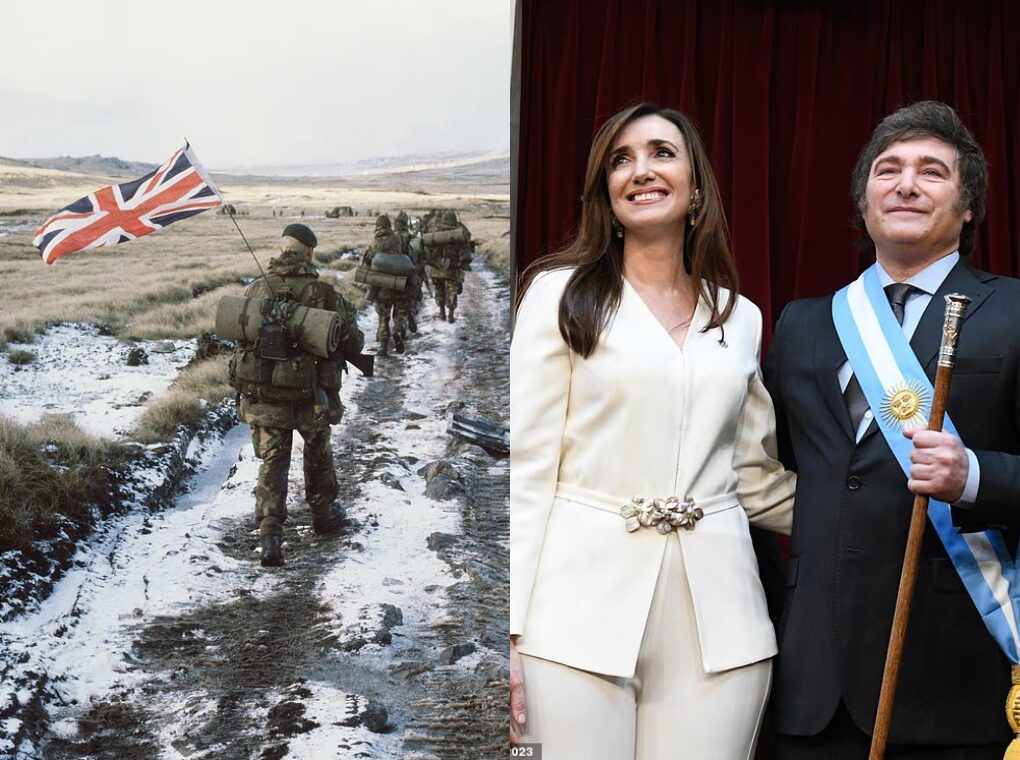
Argentina’s Vice President Victoria Villarruel has ignited a fresh diplomatic controversy after telling residents of the Falkland Islands that they should “go back to Britain” if they consider themselves English.
Her remarks come amid renewed tensions between Argentina and the United Kingdom over the sovereignty of the islands—referred to as the Malvinas in Argentina.
Villarruel’s Comments Spark Outrage
In a series of posts on X Villarruel strongly reaffirmed Argentina’s claim over the islands, stating that “today more than ever, the Malvinas are Argentine.” She argued that the sovereignty dispute should be handled strictly between governments and not involve the islanders themselves.
“The discussion over sovereignty is between states,” she wrote, adding that the United Kingdom must negotiate directly with Argentina based on “legal, historical, and geographical reasons.”
However, the situation escalated when she dismissed the identity of the islanders—commonly known as “Kelpers.” Responding to a social media user, Villarruel said: “If they feel English, they should go back to the thousands of miles away where their country is.”
Her comments have drawn criticism for undermining the principle of self-determination, which remains central to the UK’s position on the issue.
President Milei Reinforces Argentina’s Claim
The controversy follows recent statements by Argentina’s President Javier Milei, who reiterated his country’s stance that the islands “were, are, and will always be Argentine.”
Milei has consistently pushed Argentina’s claim over the territory, while also emphasizing that any resolution should ideally be achieved through peaceful and diplomatic means. He has previously acknowledged that the islands are currently under British control and admitted there is no immediate solution.
In earlier remarks, Milei suggested that Argentina should focus on becoming economically and politically strong enough that the islanders might one day voluntarily choose to align with Argentina.
UK Responds with Firm Position
The United Kingdom has responded by reiterating its long-standing position that the Falkland Islands are British and that the wishes of the islanders must be respected.
UK Home Secretary Yvette Cooper stated that Britain’s commitment is “unwavering,” adding: “Sovereignty rests with the UK, and self-determination rests with the islanders.”
This stance is backed by the 2013 referendum, in which an overwhelming majority of Falkland Islanders voted to remain a British Overseas Territory.
Historical Background: The Falklands War
The dispute over the islands dates back decades and was most notably marked by the Falklands War.
The conflict began in April 1982 when Argentina invaded the islands, prompting then British Prime Minister Margaret Thatcher to deploy a military task force. After ten weeks of fighting, British forces regained control of the territory.
The war resulted in the deaths of 255 British servicemen, 649 Argentine personnel, and three islanders, leaving a lasting legacy on both nations.
Rising Political and Diplomatic Tensions
Villarruel’s remarks come at a time of heightened geopolitical discussion surrounding the islands. Reports have suggested that the Pentagon may review aspects of the UK’s claim, although no formal policy change has been confirmed.
Meanwhile, UK political figure Nigel Farage is reportedly planning a visit to Argentina, where he is expected to reiterate that British control of the Falkland Islands is “non-negotiable.”
A Long-Running Dispute with No Easy End
The Falkland Islands dispute remains one of the most enduring territorial conflicts in modern geopolitics, shaped by history, national identity, and international law.
Argentina continues to assert its claim based on historical and geographical grounds, while the United Kingdom maintains that the principle of self-determination—clearly expressed by the islanders—must take precedence.
Villarruel’s latest comments are likely to further strain diplomatic relations, highlighting the sensitivity of the issue more than four decades after the Falklands War.
As both sides continue to stand firm, the prospect of a near-term resolution appears unlikely, keeping the Falkland Islands at the center of international political debate.