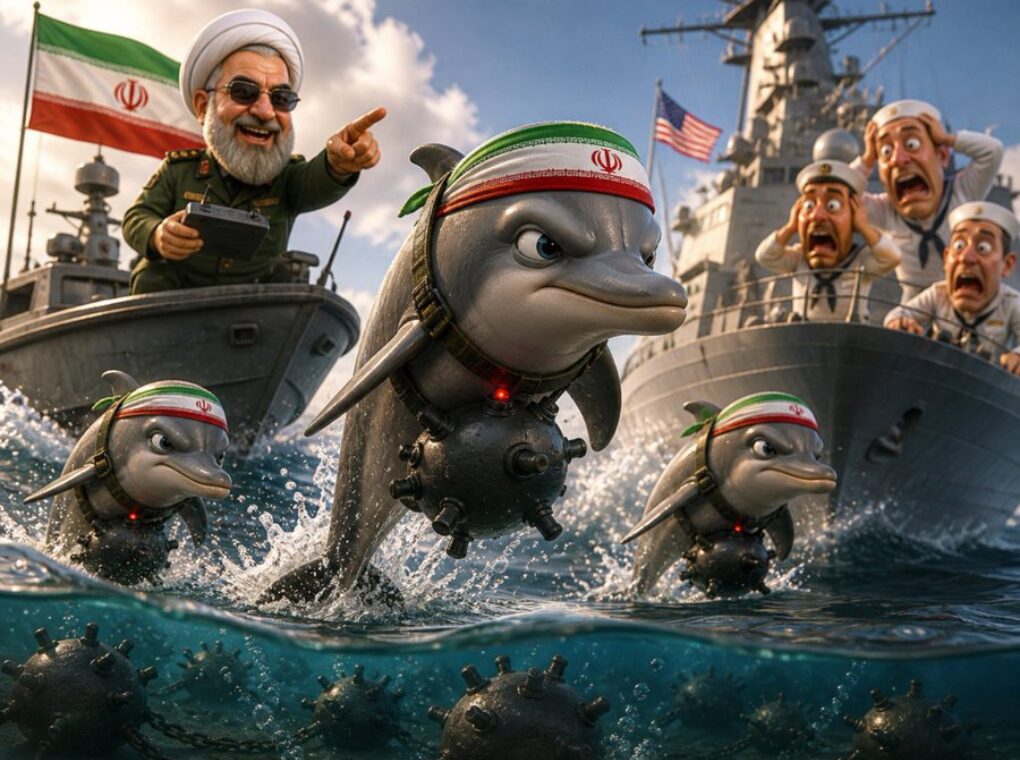
Tensions in the Middle East have taken an unusual and unsettling turn following reports that Iran is considering deploying mine-carrying dolphins to target American warships in the strategically vital Strait of Hormuz. The claim, first highlighted by The Wall Street Journal, has sparked global debate over both the feasibility and implications of such an unconventional military tactic.
According to the report, discussions within sections of Iran’s leadership suggest that Tehran may explore “previously unused weapons” as it responds to mounting pressure from the United States. Among the options reportedly being considered is the deployment of trained marine mammals equipped with naval mines—an idea that has quickly captured international attention due to its unusual nature.
Strategic Context: Why the Strait of Hormuz Matters
The Strait of Hormuz remains one of the most critical maritime chokepoints in the world. Nearly 20 percent of global oil and liquefied natural gas shipments pass through this narrow waterway, making it central to global energy security. Any disruption in the strait has immediate consequences for international markets, often leading to spikes in oil prices and heightened geopolitical uncertainty.
The current tensions stem from an intensifying standoff between Iran and the United States. A U.S.-led blockade has significantly curtailed Iran’s oil exports, placing severe strain on the country’s economy. Within Tehran, some policymakers and hardline factions increasingly view these measures not merely as economic pressure but as a form of warfare.
This perception has driven discussions around escalatory responses, including unconventional and asymmetric strategies aimed at countering U.S. military superiority in the region.
Asymmetric Warfare and Unconventional Tactics
Iran has long relied on asymmetric warfare to offset its conventional military limitations. This approach involves leveraging tactics that exploit unpredictability and environmental advantages, such as naval mines, fast attack craft, drones, and cyber operations.
The reported consideration of mine-carrying dolphins fits into this broader strategic framework. By potentially using marine animals to approach enemy vessels undetected, Iran could theoretically bypass certain defensive systems designed to counter traditional threats.
However, defense analysts caution that such a concept, while attention-grabbing, faces significant operational challenges.
Military Use of Dolphins: A Historical Perspective
Despite sounding unusual, the use of dolphins in military operations is not without precedent. The U.S. Navy Marine Mammal Program has trained dolphins and sea lions for decades, primarily for defensive roles such as mine detection, harbor security, and locating underwater threats.
During the Cold War, the Soviet Union also developed a military dolphin program, reportedly training animals for tasks that included detecting divers and attaching devices to enemy vessels. Following the collapse of the Soviet Union, elements of this program were reportedly transferred to other countries, with some reports suggesting that Iran may have acquired trained dolphins from Ukraine in the early 2000s.
However, the current status and capabilities of any such program in Iran remain unclear, with no independent verification available.
Practical Challenges and Limitations
Experts emphasize that turning dolphins into offensive weapons—particularly for complex missions involving explosives—would be extremely difficult. Dolphins are highly intelligent and social animals, but they are not programmable systems like drones.
Training them for precise, one-way combat operations would involve significant unpredictability. Factors such as environmental conditions, stress, and instinct could disrupt missions. Additionally, maintaining control over the animals in an active combat zone presents a major challenge.
Modern naval forces are also equipped with advanced underwater detection systems, including sonar and anti-diver countermeasures, which could identify unusual underwater activity. This reduces the likelihood of such tactics achieving strategic success against well-defended targets.
Ethical and Psychological Dimensions
Beyond the technical challenges, the reported plan raises serious ethical concerns. The use of animals in warfare, particularly in potentially lethal roles, is widely debated and often criticized by animal rights advocates.
At the same time, analysts note that the psychological impact of such reports should not be underestimated. Even the suggestion of unconventional weapons can influence military planning and force adversaries to prepare for a broader range of threats.
In this sense, the discussion itself may serve as a form of strategic signaling, aimed at increasing uncertainty and complicating the operational environment for U.S. forces in the region.
No Confirmed Deployment—But Rising Concerns
As of now, there is no confirmed evidence that Iran has deployed mine-carrying dolphins in the Strait of Hormuz. The reports indicate that the idea is under consideration rather than an active operational plan.
Nevertheless, the emergence of such discussions highlights the evolving nature of the conflict. It underscores how escalating tensions and economic pressure can push states toward exploring unconventional—and sometimes extreme—military options.
Broader Implications for Global Security
The situation in the Strait of Hormuz continues to be closely monitored by governments and markets worldwide. Given the waterway’s importance to global energy supplies, any escalation carries far-reaching consequences beyond the immediate region.
The reported consideration of unconventional tactics, including the use of trained marine animals, reflects a broader shift toward unpredictability in modern warfare. As traditional power dynamics are challenged, strategies that once seemed improbable are increasingly entering mainstream discussion.
For policymakers and military planners, the key concern is not just whether such tactics will be used, but what their consideration signals about the trajectory of the conflict.
With tensions remaining high and the risk of miscalculation ever-present, the Strait of Hormuz stands as a focal point of global geopolitical uncertainty—where even the most unexpected ideas can have serious real-world implications.