
As the world watches US President Donald Trump sit across the table from Chinese President Xi Jinping in Beijing, another diplomatic theatre is quietly unfolding thousands of kilometres away in New Delhi — one that could prove equally significant for the future of the global energy market and the fragile stability of the Middle East.
Over the next 48 hours, two parallel conversations may shape the direction of the worsening oil and geopolitical crisis linked to Iran, the Strait of Hormuz, and the wider West Asian conflict. One is loud, public, and confrontational. The other is quieter, multilateral, and potentially more pragmatic.
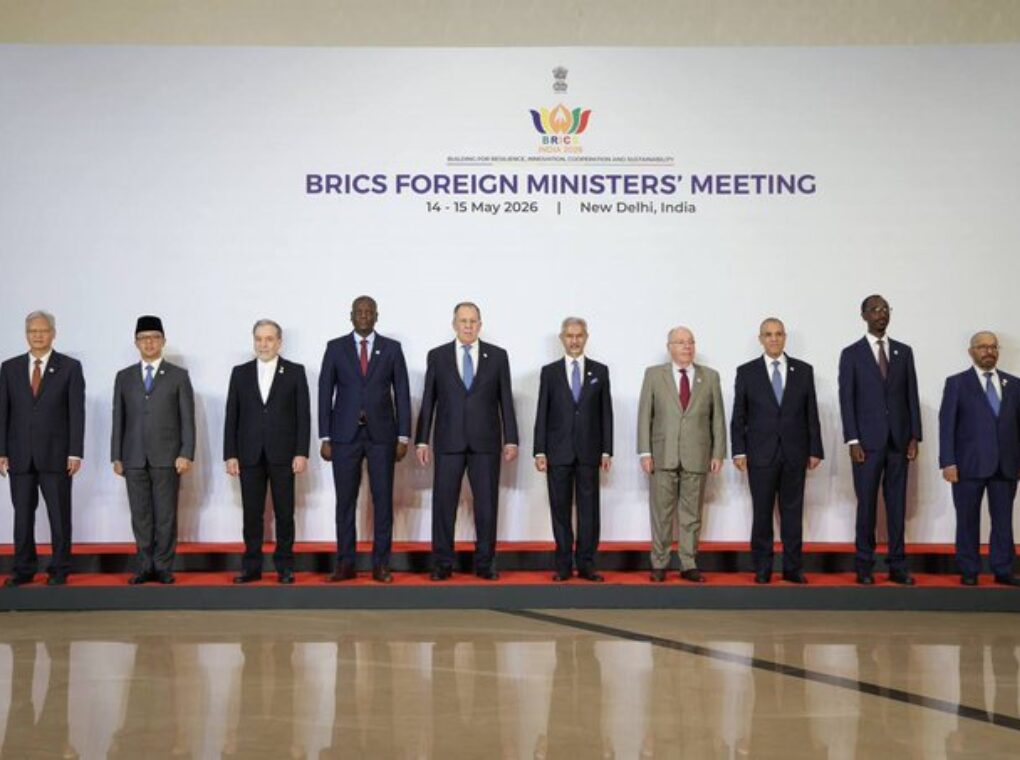
While Trump attempts to pressure China into distancing itself from Iran amid escalating tensions in the Gulf, India is hosting the BRICS Foreign Ministers’ Summit in New Delhi, bringing together key players who collectively hold influence over both the conflict and the global energy supply chain.
Among those attending are Iranian Foreign Minister Abbas Araghchi and Russian Foreign Minister Sergey Lavrov. Chinese Foreign Minister Wang Yi is absent due to the Trump-Xi meeting in Beijing, though China is still represented through its ambassador to India.
The optics of the New Delhi summit are remarkable. Under one roof sit Iran, Saudi Arabia, the UAE, Russia, India, and China — nations with sharply differing positions on the Middle East crisis, yet all part of the expanding BRICS bloc. Saudi Arabia and the UAE remain closely tied to Washington and host American military bases, while Iran has increasingly aligned itself with Russia and China amid Western sanctions and military pressure.
Despite those divisions, India appears determined to position itself as a balancing force.
Prime Minister Narendra Modi and External Affairs Minister Subrahmanyam Jaishankar have carefully avoided taking openly partisan positions in the conflict while maintaining dialogue with all sides. That strategy is now being tested at a moment when the global economy is increasingly vulnerable to disruptions in oil supply.
The Strait of Hormuz — through which nearly one-fifth of the world’s oil passes — remains under severe strain following escalating military tensions and repeated threats of closure. Insurance costs for shipping have surged, tanker movements have slowed, and global crude markets remain highly volatile.
India, the world’s third-largest oil importer, has direct stakes in preventing further escalation. Thirteen Indian ships are reportedly still stranded in or around the Strait, while New Delhi has already evacuated more than 2,500 Indian nationals from Iran through emergency land routes.
Diplomatic engagement between India and Iran has intensified significantly in recent months. Jaishankar has reportedly spoken multiple times with Araghchi since February, reflecting New Delhi’s urgent concern over energy security and regional stability.
The BRICS summit could therefore evolve into more than a symbolic gathering. For the first time since the latest phase of the Middle East crisis began, key regional powers with competing interests are sitting together in a forum outside direct Western influence.
That creates possibilities that traditional Western-led diplomatic platforms have struggled to achieve.
Backchannel understandings on shipping security, de-escalation measures, and oil transit guarantees could emerge quietly from New Delhi. Even limited consensus between Iran and Gulf Arab states would carry enormous implications for energy markets already shaken by war fears and inflationary pressure.
Unlike the United States and NATO allies, which have largely approached the crisis through military deterrence and sanctions, BRICS members appear focused on preserving economic stability and uninterrupted energy flows. That difference in approach may become increasingly important as global markets react nervously to every development in West Asia.
India’s role is particularly noteworthy. As current BRICS chair, New Delhi has attempted to maintain neutrality while positioning itself as a trusted interlocutor between rival blocs. Modi’s diplomatic schedule underlines the importance India attaches to the summit’s outcome.
Following the BRICS meetings, Modi is expected to travel to the United Arab Emirates and several European nations, carrying the results of the New Delhi discussions directly into subsequent high-level engagements. His expected meeting with UAE President Mohamed bin Zayed Al Nahyan will mark their second face-to-face interaction in just five months.
The timing is critical.
The fragile US-Iran ceasefire is increasingly unstable, the Strait of Hormuz remains vulnerable, and global oil markets are reacting sharply to every sign of escalation. A prolonged disruption could push energy prices dramatically higher, worsening inflation and slowing growth across major economies.
Against that backdrop, the contrast between Washington’s and BRICS’ approaches has become increasingly visible.
Trump’s strategy in Beijing appears focused on publicly pressuring China to isolate Iran economically and strategically. Meanwhile, BRICS nations gathering in New Delhi are attempting something more complex: managing competing interests without forcing outright alignment.
Whether those quiet discussions produce tangible breakthroughs remains uncertain. Deep mistrust between several participants still exists, and BRICS itself has struggled to present unified positions on major geopolitical crises.
Yet at a moment when Western diplomacy appears increasingly locked into confrontation, the significance of simply bringing adversaries into the same room should not be underestimated.
For now, the world’s attention may remain fixed on Beijing. But some of the most consequential conversations about the future of the Middle East — and the global energy system — may actually be taking place quietly in New Delhi.