
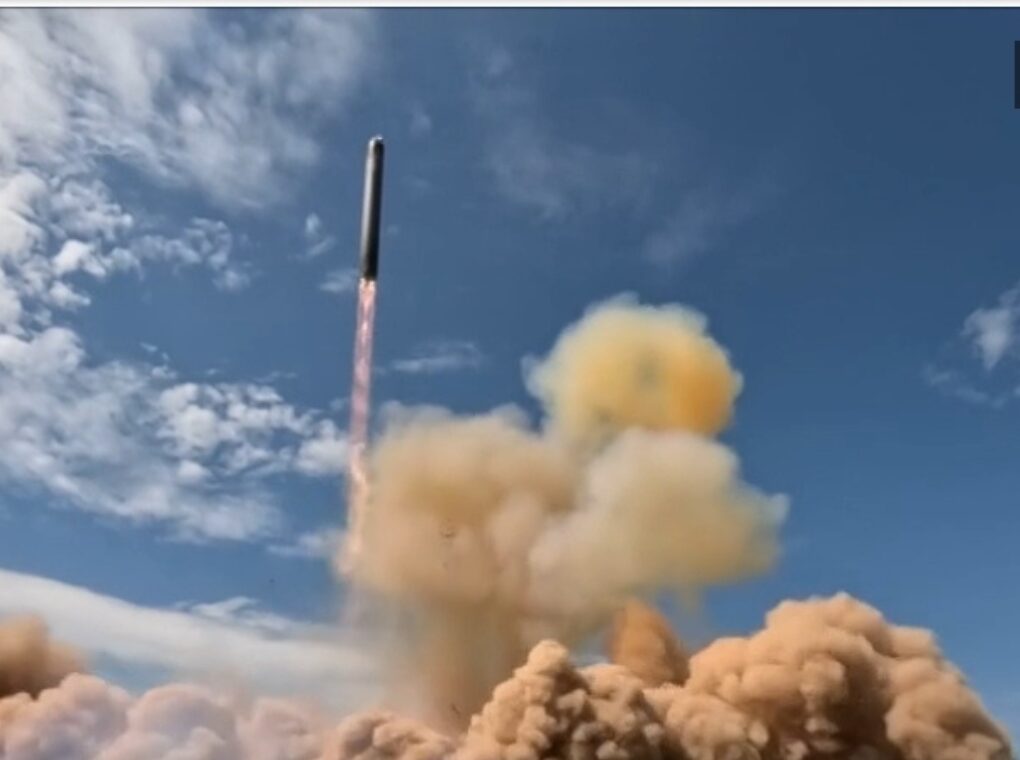
A new global race for Intercontinental Ballistic Missiles (ICBMs) is rapidly unfolding as major military powers modernize their strategic arsenals amid rising geopolitical tensions, collapsing arms-control agreements, and rapid advances in missile technology.
From Russia’s recent RS-28 Sarmat launch to China’s expanding missile silos, the United States’ modernization drive, India’s Agni-V developments, Türkiye’s newly unveiled long-range missile ambitions, and growing concerns over Pakistan’s strategic capabilities, the world is witnessing the emergence of a more dangerous and multipolar nuclear missile competition.
Security experts warn that the renewed focus on ICBMs resembles a modern version of the Cold War arms race — but with far more actors, fewer treaties, and increasingly advanced technologies such as hypersonic glide vehicles, MIRVs, and maneuverable warheads.
Russia Pushes Forward With Sarmat ICBM
Russia recently intensified global attention on strategic weapons after testing its RS-28 Sarmat heavy ICBM, known in NATO as “Satan II.”
Russian President Vladimir Putin described the Sarmat as “the most powerful missile system in the world,” claiming it can carry multiple nuclear warheads and penetrate advanced missile defense systems.
The missile reportedly traveled thousands of kilometers during its latest test launch from the Plesetsk Cosmodrome to the Kamchatka Peninsula. Russia plans to deploy the Sarmat operationally later in 2026 as a replacement for aging Soviet-era systems.
The test came shortly after the expiration of the New START treaty between Russia and the United States, which had imposed limits on strategic nuclear deployments. Analysts believe Moscow’s missile demonstrations are intended both to reinforce deterrence and to send a geopolitical signal to NATO amid continuing tensions over Ukraine and Europe.
United States Modernizes Nuclear Deterrence
The United States continues routine testing of its Minuteman III ICBMs while pursuing long-term modernization through the Sentinel program.
Unlike Russia’s highly publicized missile rhetoric, Washington emphasizes reliability, readiness, and strategic stability. Multiple unarmed Minuteman III launches over the past year demonstrated the operational capability of America’s land-based nuclear deterrent.
The US currently maintains around 400 deployed ICBMs as part of its nuclear triad, alongside submarine-launched ballistic missiles and strategic bombers.
American defense planners argue modernization is essential as China rapidly expands its nuclear forces and Russia deploys next-generation strategic weapons.
China Expands Missile Silos and Hypersonic Capabilities
China’s nuclear modernization is now considered one of the fastest-growing strategic programs in the world.
Beijing has accelerated construction of massive missile silo fields while deploying advanced solid-fuel ICBMs capable of reaching the continental United States. Estimates suggest China now possesses more than 400 long-range missile systems, with numbers projected to rise significantly by 2030.
China also conducted a rare long-range ICBM test involving the DF-31AG missile toward the South Pacific in 2024.
Military analysts say China is aggressively developing MIRV-equipped missiles, hypersonic glide vehicles, and maneuverable reentry systems designed to evade US missile defenses.
The rapid buildup is viewed as part of Beijing’s broader military strategy amid intensifying rivalry with Washington in the Indo-Pacific and growing tensions surrounding Taiwan.
India Strengthens Agni-V and Strategic Triad
India has emerged as a major strategic missile power through continuous development of the Agni missile family.
The Agni-V missile, with a range exceeding 5,000 kilometers, is considered India’s most advanced long-range nuclear-capable missile currently in service. It is road-mobile, potentially MIRV-capable, and forms a critical pillar of India’s nuclear deterrence posture.
New Delhi has also advanced hypersonic missile research and submarine-launched strategic systems as part of efforts to strengthen its nuclear triad.
India officially maintains a doctrine of “credible minimum deterrence,” with its missile development primarily focused on countering strategic threats from China and Pakistan.
Defense experts believe India’s growing missile capabilities are reshaping the strategic balance across Asia.
Türkiye Enters Long-Range Missile Competition
Türkiye has also emerged as a significant new player in the global long-range missile race after unveiling advanced ballistic missile systems and signaling ambitions that extend into the ICBM category.
At the SAHA 2026 defense exhibition in Istanbul, Türkiye unveiled the “Yıldırımhan” missile, described by Turkish media as the country’s first intercontinental ballistic missile with a reported range of approximately 6,000 kilometers.
Turkish officials say the missile can reach hypersonic speeds of up to Mach 25 and represents a major leap in Ankara’s indigenous defense industry.
The unveiling follows recent testing of Türkiye’s Tayfun ballistic missile program, including the Tayfun Block-4 hypersonic-capable system, which reportedly achieved extended ranges during recent trials.
Defense analysts note that Türkiye’s missile program has evolved rapidly from short-range systems like Bora to medium-range projects such as Cenk and now toward strategic long-range systems.
Although Türkiye does not possess nuclear weapons, experts say the development of long-range ballistic missiles significantly expands Ankara’s strategic reach and geopolitical influence.
Pakistan’s Missile Ambitions Under Scrutiny
Pakistan’s missile program has historically focused on medium-range systems designed for deterrence against India. However, recent US intelligence assessments and sanctions have raised concerns about Islamabad’s pursuit of more advanced long-range missile technology.
The United States imposed sanctions on Pakistani entities in late 2024 over alleged involvement in advanced ballistic missile development and large rocket motor projects.
While no publicly verified Pakistani ICBM test has occurred, analysts believe continued progress in propulsion and guidance systems could eventually expand Pakistan’s missile reach beyond South Asia.
The issue has added another layer of concern to an already fragile regional security environment.
A Dangerous New Multipolar Missile Era
Several major factors are driving the renewed ICBM race worldwide.
The collapse of traditional arms-control frameworks, particularly the expiration of New START, has removed key limitations on strategic arsenals. At the same time, rapid advances in hypersonic weapons, MIRVs, decoys, and missile-defense penetration technologies are encouraging nations to modernize faster.
Geopolitical tensions are also escalating simultaneously across multiple regions — including Russia-NATO confrontation in Europe, US-China rivalry in the Indo-Pacific, India-China border disputes, and India-Pakistan competition in South Asia.
Unlike the Cold War, today’s nuclear environment is no longer dominated by only two superpowers. Instead, multiple states are simultaneously developing advanced strategic missile systems, making deterrence calculations far more complicated.
Rising Risks for Global Stability
Strategic analysts warn that the accelerating ICBM race increases the risk of miscalculation, arms-race instability, and accidental escalation.
As Russia deploys Sarmat missiles, China expands silos, the US modernizes its deterrent, India strengthens its strategic triad, Türkiye pushes into long-range missile development, and Pakistan explores advanced capabilities, global security dynamics are entering a more volatile phase.
Calls for renewed multilateral arms-control negotiations involving not only Washington and Moscow but also Beijing and other emerging missile powers are growing louder. However, deep geopolitical mistrust and intensifying strategic rivalry continue to hinder meaningful diplomatic progress.
For now, the world is entering a new strategic era where long-range missile power is once again becoming central to global military competition and international deterrence politics.