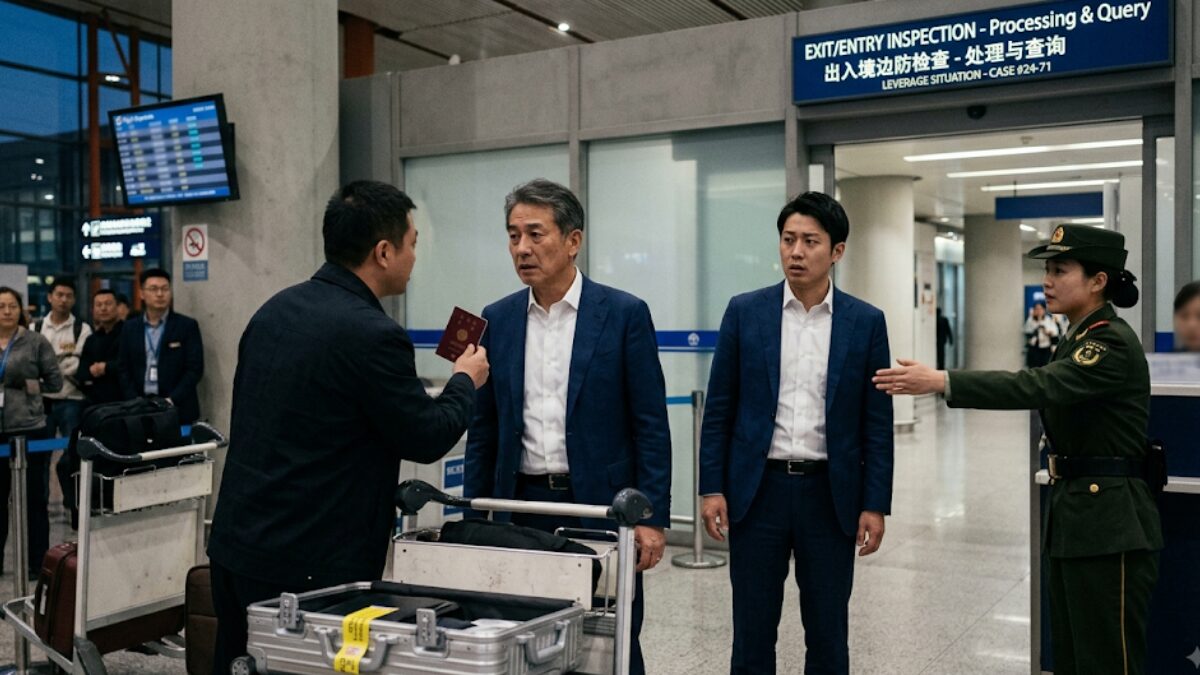
China has detained several Japanese nationals, including senior executives of companies with offices in the country, over alleged breaches of export controls on dual-use goods, Japan’s Mainichi newspaper reported on 11 August. Officials seized some of the men as soon as they entered the country.
The newspaper said authorities wanted their cooperation with ongoing inquiries, and the detentions cap months of pressure that already included repeated inspections of Japanese corporate offices and staff questioning. China’s foreign ministry declined to confirm the cases; spokesman Guo Jiakun said only that “China’s competent authorities have investigated and handled criminal cases in accordance with the law.”
Dual-use items cover goods, software and technology with both civilian and military applications, including the critical minerals used to build drones and advanced semiconductors.
Why Beijing Is Squeezing Japan
The trigger lies in a single sentence. On 7 November 2025, Prime Minister Sanae Takaichi told parliament that a Chinese attack on Taiwan could threaten Japan’s survival — wording that would let Tokyo deploy its forces. Beijing demanded a retraction. Takaichi declined.
Retaliation followed quickly. China suspended group tourism to Japan, banned Japanese seafood, and stepped up military activity near Okinawa, before reaching for trade. On 6 January 2026, the commerce ministry barred exports of dual-use items to Japanese military end users — timing that mattered, since Japan had relied on China for 63 per cent of its rare earth imports in 2024.
Beijing widened the net on 24 February, blocking dual-use exports to 20 Japanese firms, including units of Mitsubishi Heavy Industries, Kawasaki Heavy Industries and Fujitsu, and placing 20 more, among them Subaru, on a watchlist. China said the measures were meant to curb Japanese remilitarisation. Tokyo protested the same day, with Deputy Chief Cabinet Secretary Sato Kei calling the move “deplorable” and Japan’s foreign ministry telling Chinese diplomats the measures were “absolutely unacceptable.”
Goods were the first lever. People are the second.
Detention as an Instrument
The record is long. Kyodo News counts 17 Japanese nationals detained since China’s counter-espionage law took effect in 2014. In July 2025, a Beijing court jailed an Astellas Pharma employee for three and a half years on espionage charges, a verdict Ambassador Kenji Kanasugi called “extremely regrettable.”
The current wave began in Dalian in May, when Chinese authorities held two employees of the Fuji Electric group, accusing them of concealing controlled rare-earth magnets inside finished products bound for Japan. Chief Cabinet Secretary Minoru Kihara confirmed the detentions in June.
Beijing then recruited the public. On 24 June, the commerce ministry announced rewards for informants who report breaches of mineral export controls, a scheme that took effect on 1 July and also invites reports against logistics firms, customs agents and banks — turning suppliers, couriers and colleagues into potential witnesses.
The stakes for those held are severe. Under Chinese criminal law, smuggling goods banned from export carries up to five years in prison, with serious cases carrying longer terms; companies can be fined and responsible staff prosecuted individually. Japan’s embassy in Beijing issued an alert in July warning firms that controls had tightened and urging them to seek help if authorities suspected them — though notably, it offered no assurance that compliance would keep anyone out of a cell.
The Chill in the Boardroom
The commercial effect is measurable. In a survey covering the first half of 2026, 44 per cent of Japanese companies operating in China said conditions had worsened, a figure that rose seven points from the previous half, with many respondents asking for measures to protect expatriate staff and their families.
Supply chains are tightening too. Chinese customs data showed rare-earth magnet exports to Japan fell to 123 tonnes in May, down 34.6 per cent from April, and from 15 September new exit-entry rules will further restrict travel by Chinese engineers in controlled industries.
Has the Pressure Worked?
Not as Beijing intended, analysts argue. The Center for Strategic and International Studies wrote that the coercion hardened Japanese opinion and made backing down politically untenable for Takaichi, who went on to win a landslide in the February election. The East Asia Forum, meanwhile, argued the campaign is accelerating Japan’s defence build-up and its hunt for alternative suppliers.
Tokyo keeps asking. Takaichi raised the detentions with President Xi Jinping in Gyeongju in October 2025 and demanded early releases. Ten months on, more Japanese sit in Chinese custody, not fewer.
Chinese tourist arrivals in Japan fell 56.4 per cent year on year in the first half of 2026, to 2.06 million.