
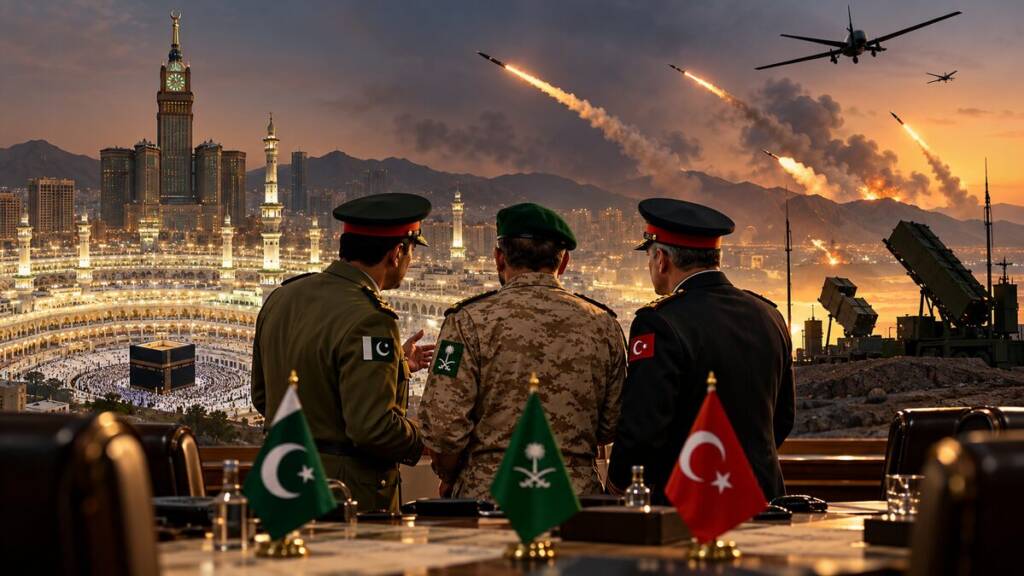
The military chiefs of Pakistan, Saudi Arabia and Turkey met in Riyadh on 25 September to forge closer defence ties. They discussed intelligence sharing, military coordination and capability integration. The talks came as Yemen’s Houthis kept firing missiles and drones at Saudi cities and, Riyadh says, at Makkah itself.
Yet seven weeks after signing a mutual defence pact, Pakistan and Turkey have offered Riyadh words rather than warplanes.
What the Makkah Pact Chiefs Discussed
Field Marshal Asim Munir, Pakistan’s Chief of Defence Forces, joined Turkey’s Chief of General Staff, General Selcuk Bayraktaroglu. Together they met Saudi Chief of General Staff General Fayyadh bin Hamed Al-Ruwaili.
The chiefs reviewed the threats facing Saudi Arabia, according to the Saudi Defence Ministry and Pakistan’s military, and condemned Houthi attacks on Makkah and on the kingdom’s civilian and economic infrastructure.
Pakistan’s military said the chiefs also explored ways to “further advance cooperation” among their armed forces. They affirmed collective defence and vowed to turn the pact’s commitments into effective cooperation.
A Pact Tested Within Weeks
The three nations signed the Makkah Joint Defence Agreement in the holy city on 7 August. Its signatories were Saudi Crown Prince Mohammed bin Salman, Turkish President Recep Tayyip Erdogan and Pakistani Prime Minister Shehbaz Sharif.
The pact treats an armed attack on any member as an attack on all three — a clause analysts compare to Nato’s Article 5.
The first test came on 8 September, when the Houthis launched a drone and missile barrage at Saudi military and energy sites. Neither Islamabad nor Ankara joined Riyadh’s counter-strikes; both chose firm diplomatic statements instead.
On 15 September, Saudi air defences destroyed a Houthi drone heading toward Makkah. Coalition spokesman Turki al-Maliki called the security of pilgrims “a red line.” Houthi leader Abdel-Malik al-Houthi rejected the claim as a “heinous lie.”
The attacks have not stopped. A Houthi drone strike in Taif killed a Yemeni resident on 17 September, Saudi civil defence said. On 24 September, Saudi forces shot down six ballistic missiles targeting Taif and Yanbu.
Words, Not Warships
So far, Pakistan and Turkey have answered each Houthi strike with statements rather than soldiers. Sharif called the Makkah incident a “dastardly and heinous” act, though he did not name the Houthis in his statement.
Defence Minister Khawaja Asif sounded bolder: “The Mecca agreement applies to us, and we will fulfil our duty,” he said. Yet beyond condemning the Makkah incident, there was no sign of military support. Foreign Minister Ishaq Dar also struck a cautious note after the New York meeting, speaking only of progress toward building the pact’s institutions.
Ankara has shown similar caution. Turkish state media described the New York talks as a review of “technical negotiations.” The pact also faces a legal hurdle in Turkey, where parliament may not approve the agreement until October. Turkish analysts say Ankara’s caution is deliberate.
Both nations have long avoided confrontation with Iran, which backs the Houthis.
Grim Outlook for the Pact
For now, the Makkah pact looks more like a promise than a shield.
It remains a general framework rather than an integrated military command. The three nations agreed in Istanbul on 31 August to set up a secretariat in Saudi Arabia. Seven weeks on, officials are still talking about building structures rather than deploying forces.
Meanwhile, Riyadh’s needs grow more urgent. A Pakistani official told Middle East Eye that Riyadh now sees talks with the Houthis as futile and expects a long military campaign.
Some observers see movement: reports on 25 September suggested both countries are edging closer to joining the Saudi fight. Until troops, jets or air defence batteries actually arrive, however, doubts about the pact will only deepen.
The Houthis declared a blockade on Saudi shipping in July, ending a truce that had largely held since 2022. They have since seized key points along Yemen’s Red Sea coast near the Bab al-Mandab strait.
The wider Iran war has also disrupted oil shipments through the Strait of Hormuz. Pakistan joined a Saudi-led maritime alliance in July to protect Red Sea shipping lanes, an initiative backed by fourteen countries, including Turkey and Egypt. Pakistan also signed a separate bilateral defence pact with Saudi Arabia in September 2025.