
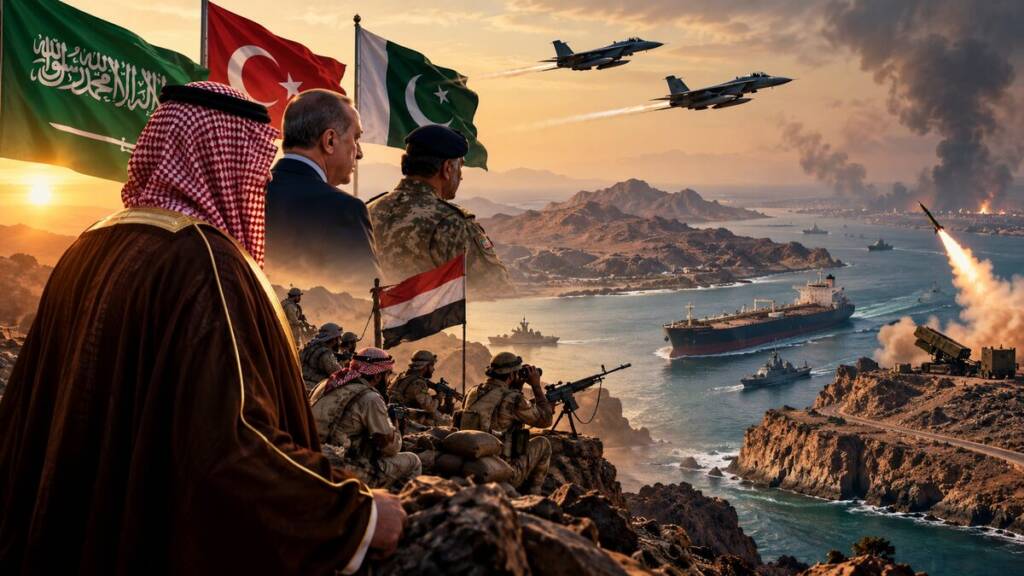
According to reports, Saudi Arabia is preparing a ground offensive against Yemen’s Houthis. Yemeni government forces will lead the fighting, and Saudi jets will strike from the air. Officials have saiud that Riyadh could mobilise more than 100,000 Yemeni troops.
According to further reports, the Saudi leadership approved the plans several days ago. Turkey and Pakistan are backing the Saudi Houthi offensive with equipment and advisers, but not combat troops.
Why the Saudi Houthi Offensive is Coming Now
A 2022 truce largely held until this year, when the Houthis began to attack Saudi shipping. In September, the Houthis captured Yemen’s Red Sea coast and took control of the Bab el-Mandeb strait. The strait links the Red Sea to the Indian Ocean. The Iran war has all but shut the Strait of Hormuz, so Saudi oil exports depend on the Red Sea.
Saudi Arabia rerouted its crude to the Red Sea port of Yanbu. Shipments there rose from about one million to 4.9 million barrels a day. The Houthis have also stepped up missile and drone attacks on the kingdom.
Diplomats said that Riyadh will not reopen peace talks while the Houthis hold the strait. Planners are weighing two options. The first is a narrow push to retake the coast around Bab el-Mandeb. The second adds coordinated attacks in Al-Bayda, Marib, Taiz and Al-Jawf.
Where Turkey Stands
Turkey signed the Mecca Joint Defence Agreement with Saudi Arabia and Pakistan on 7 August. The pact treats an attack on one member as an attack on all three.
Turkish Foreign Minister Hakan Fidan said that Ankara stands in “serious solidarity” with Riyadh. He said Turkey could meet Saudi technical military needs. Fidan also said all sides had received proposals to end the fighting.
According to report, Ankara is preparing defensive aid, not a combat role inside Yemen. Turkey’s parliament has yet to ratify the pact, and a vote is expected in October. Experts says that a clash could disrupt Turkey’s Red Sea supply line to Somalia. Turkish drones, which Riyadh bought before the war, already fly over Yemen.
Where Pakistan Stands
Pakistan has gone further than Turkey, but it has stopped short of combat. A Pakistani official said that 30,000–40,000 Pakistani troops now serve inside Saudi Arabia. Earlier reports cited about 8,000. The troops guard land borders and help intercept drones and missiles.
Pakistan also flew four cargo planes of air defence systems, artillery and drones to Aden in September. Pakistani military advisers now work beside Saudi officers who support Yemeni forces. Yet the official said Islamabad has not decided to send fighting troops into Yemen. Defence Minister Khawaja Asif has said Pakistan will fulfil its duty under the pact.
Will they fight, or sit out again?
The evidence so far points to support without combat. No Saudi ally is expected to take a direct part in the fighting. Pakistan has drawn this line before. In 2015, Pakistan’s parliament voted to stay out of Yemen but promised to protect Saudi soil.
Pakistan borders Iran and mediates between Washington and Tehran. Turkey keeps channels open to Tehran and has not listed the Houthis as terrorists. A senior Houthi official has warned both countries of a “heavy price” for intervention.
Asif said on 29 September that Pakistan would offer every available means if attacks continue. A formal Saudi request under the pact would force a clearer answer. But going with history, Pakistan will only offer excuses and empty promises.
What Else Could Shape The Fight
Washington will not bomb the Houthis for now, a US official said. The US has twice turned down Saudi requests for air strikes. US forces have instead passed Riyadh more than 200 Houthi targets in two weeks.
The offensive depends on Yemeni factions that Saudi Arabia and the UAE armed years ago. Yemen analyst Mohammed Albasha said that many of them lack the organisation for a long offensive.
Iran backs the Houthis, whom Reuters describes as Tehran’s strongest remaining regional ally. Riyadh also fears Houthi retaliation against its oil facilities and has asked allies for air defences. France has announced troops and defensive systems for Yanbu.
The World Food Programme says three in four families in government-held areas lack enough food. The agency counts 152,000 newly displaced people.
What to Watch Next
The first signal is timing, which sources place between the coming week and early November. The second is whether Riyadh chooses the narrow coastal push or the wider assault. The third is Turkey’s ratification vote and any formal Saudi request to Pakistan. For now, Ankara and Islamabad arm and advise, while Yemenis do the fighting.