
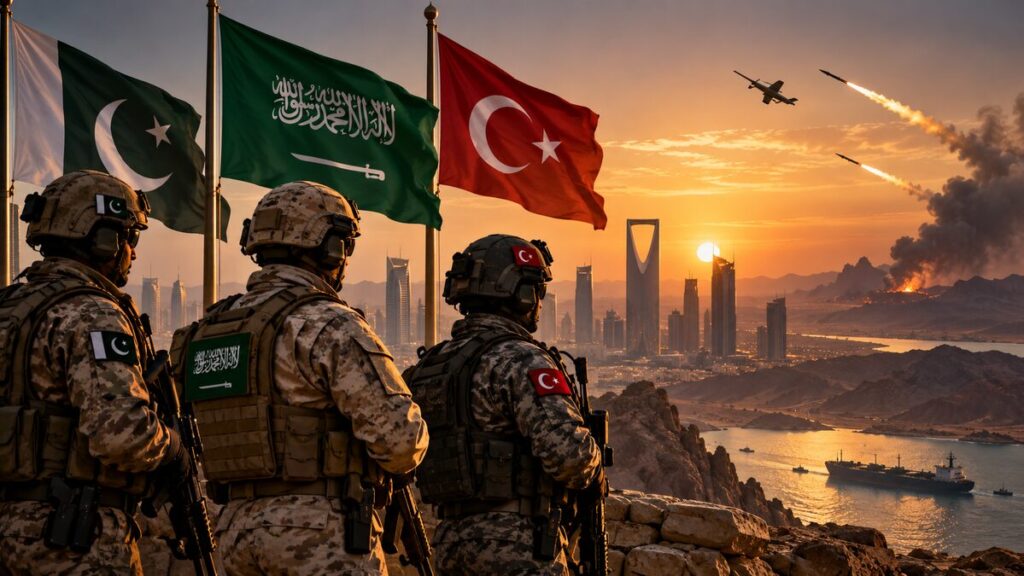
Pakistan and Turkey will send troops to Saudi Arabia as Houthi attacks on the kingdom mount. The three countries announced the move on 5 October after an emergency meeting in Riyadh.
Some headlines present the move as help for Saudi-backed forces in Yemen. The joint statement, however, places the troops inside Saudi Arabia. A frontline combat role in Yemen looks unlikely. Saudi Arabia itself fights from the air, and Yemeni soldiers hold the front line.
What the Three Countries Agreed
Defence and foreign ministers from the three countries met in Riyadh on Monday. They invoked the Mecca defence pact for the first time since its signing on 7 August. The pact treats an attack on one member as an attack on all. Saudi Defence Minister Khalid bin Salman said the alliance had agreed to activate collective deterrence measures.
A joint statement promised agreed forces and their “rapid deployment” in the kingdom. The text gave no troop numbers, no timetable and no description of duties. Each country will act under its own laws, the statement added.
Why A Frontline Role Looks Unlikely
Saudi Arabia itself is not fighting the ground war in Yemen. Its military mainly provides air cover and strikes Houthi targets. Riyadh also arms and trains Yemeni government forces. Pakistan and Turkey are unlikely to accept a ground role that Riyadh itself avoids. Pakistan’s Defence Minister Khawaja Asif described a supporting role that includes reconnaissance. He said the two countries’ forces are not conducting the combat.
Pakistan already keeps forces in the kingdom under earlier agreements. Turkey has confirmed no deployment there so far. Pakistan’s Foreign Minister Ishaq Dar has called the pact “defensive in nature”. Riyadh mainly wants help to defend Saudi territory, said Dania Thafer, executive director of the Gulf International Forum. Other analysts expect small specialist units, such as air defence crews, not large ground formations.
Turkey faces a legal step first. Only parliament can send Turkish troops abroad, and it has not yet ratified the pact. Turkish Foreign Minister Hakan Fidan spoke last month of “technical support” for the Saudi military.
Who is Actually Fighting the Houthis
Yemeni soldiers are doing the fighting on the ground. Tens of thousands of troops loyal to Yemen’s internationally recognised government have joined the offensive. Rashad al-Alimi, head of Yemen’s Presidential Leadership Council, announced the campaign on 4 October.
Government forces say they have retaken the port city of Mocha and positions near the Bab al-Mandeb strait. The Houthis deny these gains. The Saudi-led coalition says 100 of its fighter jets support the advance. The Yemeni side has limits. Its units sit on many scattered fronts and use old equipment.
Why the Alliance Acted Now
The Houthis, an ally of Iran, have held Yemen’s capital, Sanaa, since 2014. A truce from 2022 collapsed in July. In September, the group seized much of Yemen’s Red Sea coast.
Houthi missiles and drones have since struck Saudi cities, airports and oil sites. Saudi authorities said strikes hit two airports on Monday evening and injured at least three people. The joint statement condemned attempts to target Mecca and Medina, which hold Islam’s holiest sites.
Oil adds urgency. Bab al-Mandeb links the Red Sea to the Gulf of Aden. About 8.1 million barrels of crude and fuel crossed it daily in the second quarter. Iran already restricts shipping through the Strait of Hormuz during its war with the United States and Israel. Washington has declined direct combat against the Houthis for now.
What to watch next
First, how many troops will arrive, and when? Pakistan’s information ministry says operational details are confidential.
Second, will the mission stay inside Saudi Arabia? A Western official said that Pakistani personnel are already in southern Yemen. The official could not say whether they work for Pakistan’s military or Saudi Arabia’s.
Third, how will Iran react? Iran can tolerate a purely defensive deployment, Tehran-based analyst Javad Heiran-Nia told Al Jazeera. He said offensive operations against the Houthis would cross an Iranian red line. Pakistan and Turkey have both acted as mediators in the Iran war.
For now, the deployment sends a political signal more than it changes the battlefield. Middle East Eye called its immediate tactical impact unclear. A Houthi strike on foreign troops in Saudi Arabia could change that calculation quickly.