
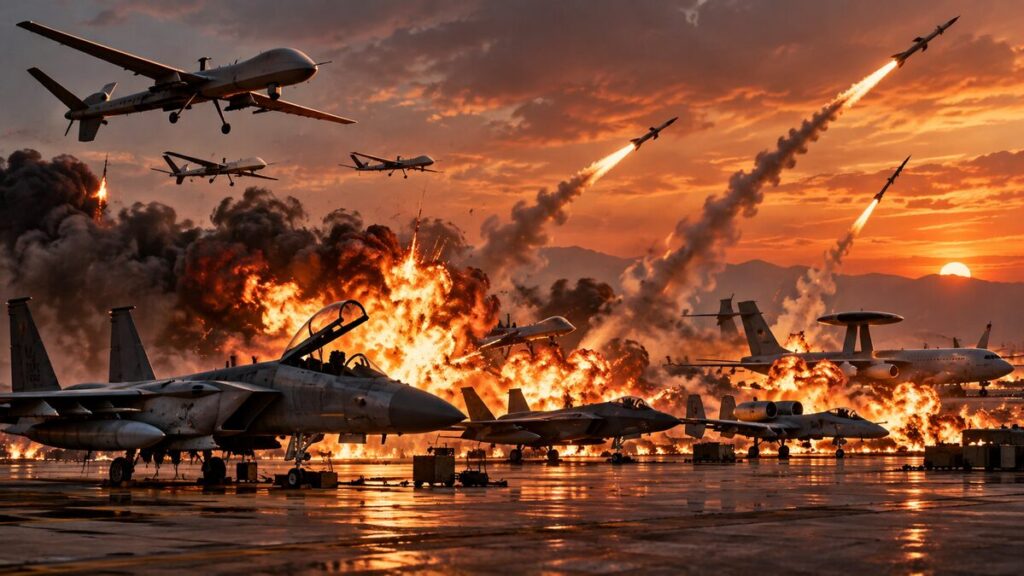
A congressional report has finally put a number on America’s air losses over Iran. The Congressional Research Service (CRS) updated its tally on 5 October 2026. It now lists 81 US aircraft lost or damaged since Operation Epic Fury began on 28 February 2026.
The May edition of the same report counted 42. The ledger has almost doubled in five months.
What the United States has lost
Drones dominate the list. CRS counts at least 45 MQ-9 Reapers. This represent roughly a quarter of the pre-war fleet, worth over $1.3 billion. The May report had listed only 24 Reapers. Crewed losses cut deeper. A Kuwaiti F/A-18 mistakenly shot down three F-15E Strike Eagles over Kuwait in early March. All six crew ejected safely. Iranian defences then downed a fourth Strike Eagle over Iran in April.
A KC-135 Stratotanker crashed over western Iraq on 12 March. All six aircrew died, and they remain the only fatalities CRS lists. Iranian missiles and drones later damaged five more tankers at Prince Sultan Air Base in Saudi Arabia.
Iran struck the same base again on 27 March. That attack hit an E-3 Sentry command aircraft parked on an unprotected taxiway.
The tally also includes a damaged F-35A, two A-10 Thunderbolt IIs and an MQ-4C Triton. American crews deliberately destroyed two MC-130J transports on the ground in Iran. A separate Pentagon inspector general report added four AH-6 Little Birds, an AH-64 Apache and an MH-60.
In September, Iranian missiles struck Muwaffaq Salti Air Base in Jordan. The barrage tore a wing off an A-10 and damaged eight F-15Es. Engineers repaired all eight jets and returned them to the flight line. Iran has hit that Jordanian base repeatedly since February.
How Iran Bleeds a Stronger Adversary
Iran cannot contest the skies. It fields no modern fighter force. So it attacks the machinery that generates American sorties instead. Tehran studied US air operations as a system. It then struck the weakest joints.
This sums up Iran’s asymmetric counterair campaign. Iran targets tankers, radars and airborne command posts, usually on the ground. It pursues air denial rather than air superiority. The economics reward Tehran handsomely. A Shahed drone costs roughly $20,000 to $50,000. A single interceptor can cost about $12 million.
Tehran exploits that gap deliberately. Drone swarms drain interceptor stockpiles. The arithmetic shows. American forces expended about 65 per cent of those interceptors between February and July. Fewer than 850 reportedly remain, down from 2,330 before the war. Volume compounds the problem. Iran fired an estimated 4,000 Shahed-136 and Arash-2 drones before the April ceasefire.
Tehran Has Adapted Under Pressure
American strikes have hurt Iran badly. Central Command claims the campaign destroyed most of Iran’s defence industrial base. Yet attrition has not broken Tehran’s missile and drone forces.
Iran has shifted tactics instead. It now launches smaller, repeated salvoes from dispersed and concealed positions. Drones also preserve Iran’s scarcer assets. Cheap airframes handle routine harassment, while ballistic missiles wait for high-value targets.
Parked Aircraft Became The Soft Target
American airpower long treated rear bases as sanctuaries. Cheap, reasonably accurate weapons have ended that comfort. Hardened shelters remain scarce across the Gulf.
Rare aircraft suffer disproportionately. The air force flies few E-3s and cannot replace them quickly. CRS has flagged exactly this gap for lawmakers.
Reapers proved fragile in the air too. They loiter low and slowly near the Strait of Hormuz. Several simply crashed after their control links failed.
The War Has Not Ended
Fighting resumed on 8 July after the April ceasefire collapsed. Negotiations remain stalled, and the Strait of Hormuz stays contested.
Costs keep climbing alongside the losses. The Pentagon’s inspector general priced the campaign at $33.4 billion through 30 June. The human toll has risen too, with roughly two dozen American troops killed and hundreds wounded.
Caution now shapes deployments far beyond the Gulf. The US Air Force withdrew its B-1B bombers from RAF Fairford in England on 4 October. According to reports, fears of an Iranian drone plot prompted the move. Iran denied any involvement.
The broader lesson travels well past this conflict. Cheap mass can bleed an expensive force. Precision and stealth cannot protect aircraft that sit still on open ramps.