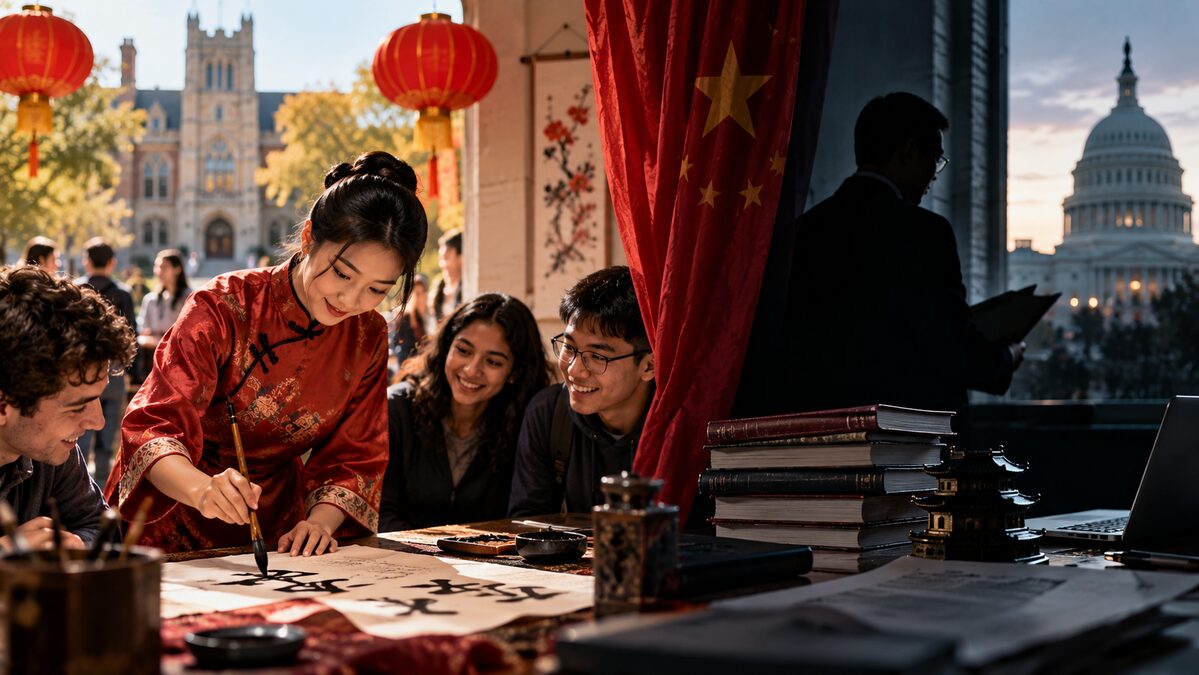
For two decades Confucius Institutes bearing gifts: free Mandarin teachers, lantern festivals, calligraphy brushes and dumpling-making evenings for curious undergraduates. Last Friday, America’s defence chief gave them a far darker label: sleeper organisations.
In a video posted on social media on 23 October, Pete Hegseth announced that the Department of War had designated China’s Confucius Institutes a threat to US national security. Congress had squeezed the centres off campus years ago, he argued, but they had crept back in disguise.
His department says it uncovered 80 successor bodies at 30 universities, operating under fresh names and charters but sharing one mission: “to steal intellectual property and to infiltrate the minds of American students”. Every one of them, Hegseth claimed, has been dismantled within the past two months.
The move caps a security audit of 30 universities launched in August, yielding more than 80 actions against risky research partnerships. Hegseth likened Beijing’s rebranding to the diversity programmes he has purged from the military, which he says also resurface under new names.
Beijing’s reply came from its military, whose social media account sarcastically asked whether learning Mandarin, kung fu, calligraphy and dance could really endanger America – and, if so, how long the US had been threatening China.
From Confucius Institutes to sharp power
The first Confucius Institute opened in South Korea in 2004, and Beijing pitched the scheme as its answer to France’s Alliance Française, Germany’s Goethe-Institut and the British Council. The crucial difference, critics note, is that those bodies stand alone, whereas Confucius Institutes are embedded inside host universities.
That arrangement gave Beijing a desk inside the academy, and the money came with strings. A bipartisan 2019 US Senate investigation found that the Chinese government controlled nearly every aspect of the institutes on American campuses, from funding and staff to programming, with veto power over events and speakers. Since 2006, Beijing had poured more than $158 million into the American network.
The FBI’s counterintelligence chief told senators that the centres were “not strictly a cultural institute”, and Chinese officials were rarely coy: Li Changchun, then the Communist Party’s propaganda chief, described the institutes in 2009 as “an important part of China’s overseas propaganda set-up”.
The ‘magic weapon’ behind the Confucius Institutes
The deeper worry is who stands behind the curtain. The Communist Party’s United Front Work Department (UFWD) is charged with cultivating friends abroad, managing the Chinese diaspora and neutralising critics. Xi Jinping calls united front work an “important magic weapon”, one that seeks to steer other countries’ policies in China’s favour by any route available, lawful or otherwise.
The institutional overlaps are hard to ignore. Liu Yandong, the state councillor who chaired the institutes’ parent body, had headed the UFWD from 2002 to 2007. A US congressional advisory commission found that the institutes were funded by the party’s Propaganda Department, formally affiliated with the UFWD, and supervised by staff in Chinese embassies and consulates. Since 2012, Xi has added some 40,000 people to the department’s ranks.
Sometimes the Chinese side says the quiet part aloud. Research by Australian scholar Clive Hamilton cites Dalian University of Foreign Languages praising its Confucius Institute staff for having “blazed a new path for united front work overseas”. Canada’s intelligence service has recorded how a Toronto school board cancelled its Confucius contract in 2014 after parents discovered the programme answered to the UFWD.
Mostly, critics argue, influence works through silence rather than spies: self-censored curricula and quiet pressure on host universities. At a 2014 academic conference in Braga, Portugal, a senior Hanban official had references to Taiwan stripped from the delegates’ materials.
Occasionally it shades into espionage. In 2019 Belgium barred Song Xinning, director of the Confucius Institute at Vrije Universiteit Brussel, from the Schengen area for eight years, after security services accused him of recruiting for Chinese intelligence. He denied it; the university ended the partnership.
The great rebrand
As pressure mounted in 2020, Beijing reorganised. The Hanban, the education ministry office that ran the programme, became the Center for Language Education and Cooperation, while a nominally non-governmental body, the Chinese International Education Foundation, took over the Confucius brand. The National Association of Scholars warned that the new foundation, technically a non-profit, would let Beijing bankroll institutes with the anonymity of a private donor.
Washington tightened the screws regardless. Successive defence authorisation acts cut Pentagon funding to host universities, and in August 2020 the State Department designated the institutes’ US headquarters a foreign mission of China. American numbers collapsed from a 2017 peak of 118 to fewer than five by 2023.
Yet closure did not always mean departure. A National Association of Scholars study found that 28 American institutions had replaced closed institutes with similar programmes, while 58 kept close ties with former Chinese partners. That is the gap Hegseth now claims to have shut.
Who has shut the door, and why
America is far from alone, though outright national bans remain rare; most closures were made by universities under political pressure. Eleven countries; the US, Canada, Australia, France, Germany, Sweden, the Netherlands, Belgium, Denmark, Spain and Switzerland have closed some or all of their institutes.
Sweden went furthest, becoming the first European country to close every institute and classroom in 2020. Relations had soured over Beijing’s detention of the Swedish publisher Gui Minhai and its relentless campaign against Swedish critics. Finland’s University of Helsinki later closed its own institute, with staff saying they wanted to choose and employ their own teachers.
Elsewhere in Europe, Leiden in the Netherlands and Lyon in France shut their centres, while German universities in Hamburg and Dortmund ended cooperation.
In Australia, the New South Wales government closed the institute housed inside its own Department of Education, along with 13 Confucius Classrooms in state schools. The Foreign Relations Act of 2020 gave Canberra power to cancel university agreements, and by 2025 six universities had closed theirs or let them lapse.
India moved after the deadly Galwan Valley clash of June 2020. Security agencies warned of growing Chinese influence in higher education, prompting a review of institutes and classrooms at seven Indian institutions and 54 agreements with Chinese universities. Beijing’s embassy asked India to act in an “objective and fair manner”, but New Delhi went on to consider mandatory government approval for academic tie-ups with its land neighbours.
Britain offers the cautionary counterexample. Rishi Sunak pledged a ban, and his security minister Tom Tugendhat said the institutes posed “a threat to civil liberties”. By 2023 the government had judged a ban “disproportionate”, leaving about 30 in place, as universities feared ministers gaining power to terminate any partnership they disliked.
Retreat in the West, advance in the South
The Western retreat masks expansion elsewhere. Chinese state media reported 16 new projects in 2025, taking the network to 510 institutions across 164 countries and regions. Courses now run in 49 African countries, and Latin America hosts more than 40 institutes. There, analysts note, Taiwan and Tibet stir far less controversy among students than in Western lecture halls.
The rectification of names
Beijing insists the institutes are transparent and never meddle in academic freedom, and Britain’s Russell Group has called them “beneficial”. They sit uneasily beside the Senate’s findings and the Brussels expulsion.