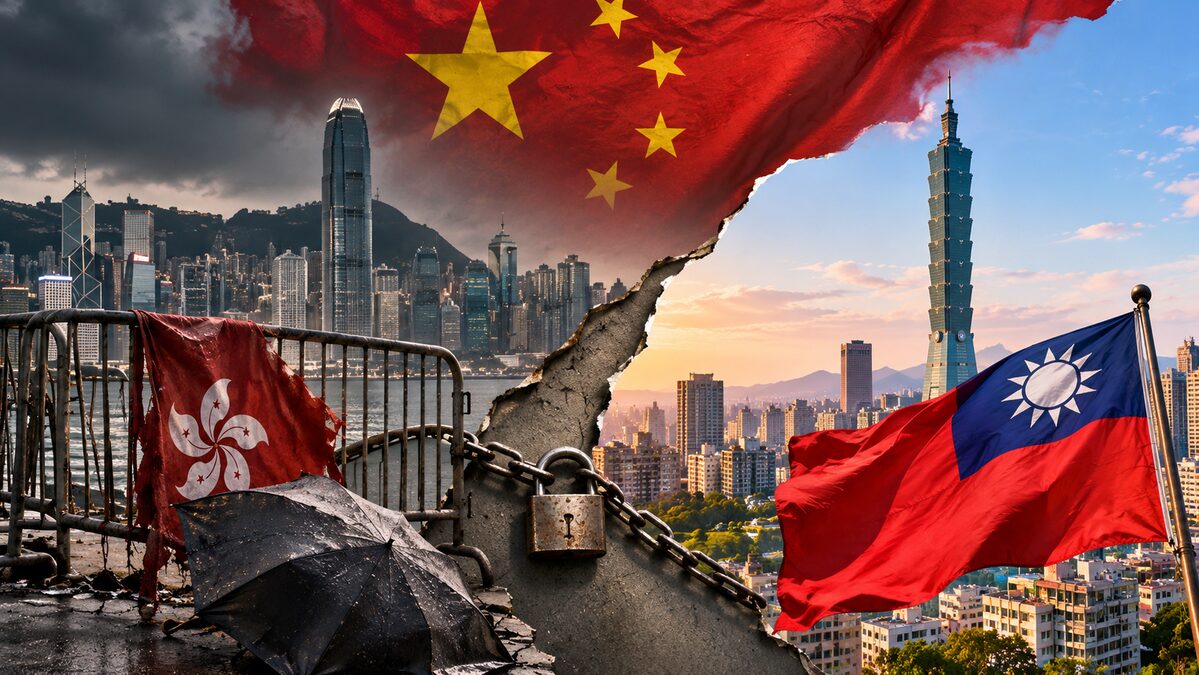
Chinese President Xi Jinping has once again put Taiwan reunification at the top of Beijing’s agenda. In a speech on 12 November, he called the task an “unwavering historical mission” of the Communist Party. He insisted that China will achieve complete reunification with the island. He stressed a peaceful path and made no mention of military force. Yet the model he offered remains the one Beijing used in Hong Kong: “one country, two systems”. That city’s recent history shows exactly what Taiwan would lose.
What did Xi say, and how did Taiwan respond?
Xi spoke at Beijing’s Great Hall of the People to mark the 160th birthday of Sun Yat-sen. Sun helped lead the 1911 revolt that ended imperial rule and ushered in the Republic of China. Taiwan’s Mainland Affairs Council dismissed the speech. It said neither the government nor the public could accept “one country, two systems”. A council spokesperson added that Beijing’s wording had barely changed.
The timing matters. Xi is due to meet US President Donald Trump at the APEC summit in Shenzhen next week. Taiwan also holds local elections on 28 November, when about 19.65 million eligible voters will choose 11,051 officials.
What does “one country, two systems” mean?
Under the formula, a region accepts Chinese sovereignty but keeps its own legal and economic system. Britain handed Hong Kong back to China on these terms in 1997. Beijing promised to preserve the city’s freedoms for 50 years. For years, Hongkongers enjoyed wide civil liberties and the rule of law. In 2020, that promise still had 27 years left to run.
What happened to Hong Kong?
Mass pro-democracy protests swept the city in 2019. Beijing answered with a national security law in June 2020. It passed the law without any vote in Hong Kong’s own legislature. The crackdown that followed dismantled almost every pillar of a free society.
- The press: Police raided Apple Daily, arrested its editors and froze its assets. The paper printed its final edition in June 2021. In February 2026, a court jailed its founder, Jimmy Lai, for 20 years. He is 78.
- The opposition: In 2024, judges jailed 45 democrats for up to 10 years. Their offence? Organising an unofficial primary election that drew more than 600,000 voters. The Democratic Party, the city’s last major opposition force, voted to disband in December 2025.
- Elections: Beijing rewrote the rules in 2021 so that only “patriots” can stand. Turnout in the December 2025 legislative poll reached just 31.9 per cent.
- New laws: In 2024, the city’s legislature unanimously passed a second security law in just 11 days.
- Exiles: Police now offer bounties for activists abroad. In July 2025, they named 19 overseas activists in a single round, the largest yet.
Amnesty International found that courts wrongly criminalised over 80 per cent of the people they convicted under the law. Beijing and Hong Kong officials reject such criticism. Pro-Beijing commentators argue that the laws apply narrowly and that courts still follow common-law rules.
Would Taiwan fare any better?
Beijing’s own documents suggest it would fare worse. White papers in 1993 and 2000 promised that Beijing would not station troops or administrators in Taiwan. In 2022, Beijing dropped that pledge.
In 2024, China issued legal guidelines that allow the death penalty for “diehard” independence supporters. The rules also permit trials in absentia. Beijing has labelled President Lai Ching-te a “separatist”. If Beijing can brand an elected president a separatist, few Taiwanese politicians could feel safe.
The pressure goes beyond the law. On the day of the speech, Taiwan’s defence ministry tracked 29 Chinese military aircraft around the island.
What do people in Taiwan think?
Taiwan has enjoyed regular, peaceful transfers of power since 2000. Freedom House rates Taiwan 93 out of 100 for freedom. Hong Kong scores just 41. Reporters Without Borders ranks Taiwan 28th for press freedom, while Hong Kong sits 140th.
Most Taiwanese want to keep it that way. In a May 2026 poll for the Mainland Affairs Council, 79.7 per cent opposed “one country, two systems”. Some 87.1 per cent refused to trade freedom and democracy for Communist Party rule. No major Taiwanese political party backs the formula.
The bottom line
Hong Kong gave the world a live test of Beijing’s formula. The test lasted 23 years before the security law hollowed it out. Only Beijing could enforce the 50-year promise, and Beijing decided when it expired. Taiwan holds something Hong Kong never had: a government its people choose in full. Taiwanese elect their president, their legislature and their mayors. Integration on Beijing’s terms would place all of that at the mercy of a party that tolerates no rivals. Xi says history cannot halt reunification. Hong Kong’s fate gives Taiwan’s 23 million people every reason to resist.