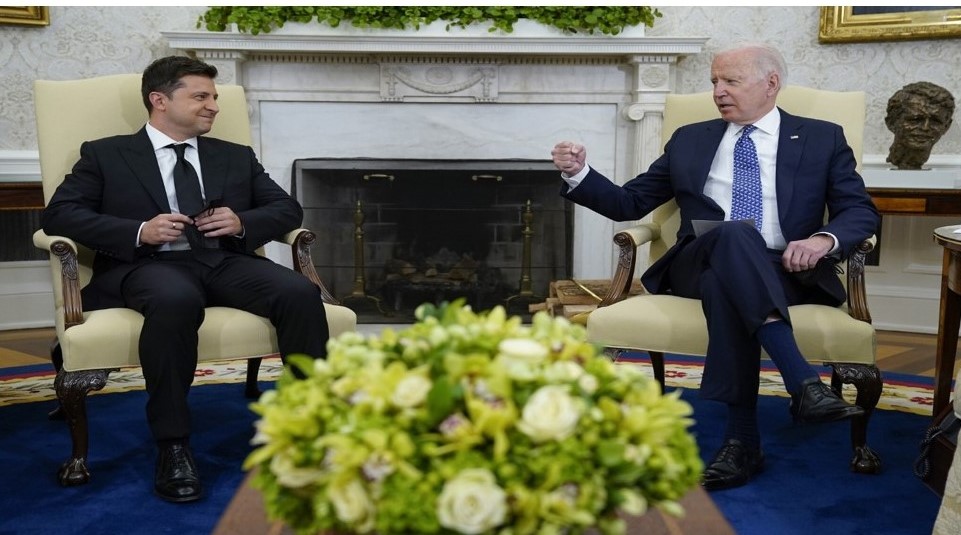
At the recent G7 Summit, U.S. President Joe Biden secured a 10-year security arrangement with Ukraine’s Volodymyr Zelensky, whose presidential term ended on May 20. This deal, hailed as “historic” by the White House, faces an uncertain future according to U.S. media.
The agreement is classified as an “executive agreement,” not a treaty, as Biden bypassed congressional approval. Treaties require a two-thirds Senate majority to become legally binding international agreements. In contrast, executive agreements are made by the President alone and do not necessarily obligate his successors.
Understanding the distinction between treaties and executive agreements is crucial in U.S. law and international diplomacy.
Treaties:
• Definition: Formally ratified agreements between sovereign states.
• Constitutional Basis: Article II, Section 2 of the U.S. Constitution allows the President to make treaties with the advice and consent of the Senate.
• Legal Status: Once ratified, treaties become part of U.S. law under the Supremacy Clause (Article VI, Clause 2 of the Constitution), making them the “supreme Law of the Land.”
• Binding Nature: Treaties are binding on future administrations unless abrogated through Senate approval or terminated according to the treaty’s terms.
Executive Agreements:
• Definition: International agreements made by the President without Senate approval.
• Constitutional Basis: While not explicitly mentioned in the Constitution, executive agreements are implied by the President’s foreign affairs powers (Article II, Section 1).
• Legal Status: Based on existing treaties, statutory authority, or the President’s constitutional powers. They do not require Senate approval and are not necessarily binding on subsequent administrations.
Types:
o Congressional-Executive Agreements: Approved by a simple majority in both houses of Congress, often used for trade deals like NAFTA.
o Sole Executive Agreements: Made by the President alone, typically addressing temporary or limited issues.
The fragility of executive agreements is evident from historical precedents. For instance, President Donald Trump dismantled the Iran nuclear deal in 2018, an executive agreement originally deemed “historic” in 2015. This example underscores the vulnerability of executive agreements to changes in administration.
Recent polls from YouGov, Yahoo News, and Emerson indicate that Trump is leading Biden in the 2024 presidential race, including in key battleground states. Even if Biden secures a second term, his presidency will end in 2029, leaving the fate of the 10-year agreement dependent on his successor.
Treaties, although requiring Senate approval, are also subject to unilateral presidential action. In 1978, President Jimmy Carter withdrew from the 1954 Mutual Defense Treaty with Taiwan. Similarly, President George W. Bush exited the Anti-Ballistic Missile (ABM) Treaty with Russia in 2002.
Other notable examples of treaty withdrawals include:
• Paris Agreement (2017): President Donald Trump announced the U.S. withdrawal from this climate change accord, effective November 2020.
• Intermediate-Range Nuclear Forces (INF) Treaty (2019): President Trump withdrew from this Cold War-era agreement with Russia, which prohibited certain land-based missiles.
• Iran Nuclear Deal (JCPOA) (2018): Trump exited the agreement aimed at limiting Iran’s nuclear program in exchange for lifting economic sanctions.
• Treaty of Amity with Iran (2018): Trump terminated this 1955 treaty, which established economic and consular relations between the two countries.
• Open Skies Treaty (2020): Trump withdrew from this agreement allowing reconnaissance flights over member countries to collect data on military forces and activities.
Finally, the legitimacy of Zelensky as a signatory to the agreement is questionable. Under Ukraine’s Constitution, the presidential term is limited to five years, with no extensions allowed even under martial law. Thus, without a clarification from Ukraine’s Constitutional Court, Zelensky’s authority to sign the deal remains in doubt.
The implications of these distinctions and historical precedents emphasize the urgent need to understand the differing legal frameworks and potential fragility of such international agreements.