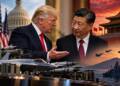
The United States and China are discussing visits to each other’s nuclear sites. The talks are informal and at an early stage.
They come eight months after the last US-Russia nuclear treaty expired. No treaty now limits the world’s two largest nuclear stockpiles, and China is adding warheads. That mix has raised fears of a new arms race.
What the Two Sides are Discussing
According to reports, China first raised the idea in meetings with US officials this year. Officials discussed visits to US Department of Energy national laboratories and to similar Chinese facilities. The US is also open to visits to nuclear testing sites, the reports said.
Most of the talks took place alongside meetings of the UN Security Council’s five permanent members.
Why the Talks Are Happening Now
Two things have changed.
First, the New START treaty expired on 5 February 2026. It limited the US and Russia each to 1,550 long-range warheads ready for use. Russia offered to keep those limits for one more year. “If it expires, it expires,” US President Donald Trump said before the deadline. “We’ll just do a better agreement.”
Second, China is building up. China had about 620 warheads in January 2026. That was 20 more than a year earlier. Christopher Yeaw, the US assistant secretary of state for arms control, went further in February. “We believe China may achieve parity within the next four or five years,” he said. Parity means equal strength.
The Case for a New Three-Country Treaty
Washington argues that the old treaty’s end creates an opening. New START covered only two countries. Yeaw called it “seriously flawed” and said it failed to cover China’s build-up. The US now wants a trilateral treaty. That means one deal binding the US, Russia and China. Supporters say limits on two powers mean little while a third keeps growing.
Trump made that case to Chinese President Xi Jinping at the White House on 24 September. He “advocated for trilateral arms control negotiations”, the White House said. China’s summary of the meeting did not mention arms control. Site visits could become a building block for such a treaty. Any treaty depends on each side checking the other.
Why China Keeps Saying No
China points to the gap in numbers. The US and Russia each have more than 5,000 nuclear weapons. China has just over 600. Xi made that point to Trump in September, a US official said. China’s foreign ministry says the two bigger powers should make deep cuts first.
Russia has its own condition. The Kremlin wants future talks to cover British and French nuclear weapons too.
How this Echoes the Cold War
In the Cold War, the US and the Soviet Union built weapons faster than they built trust. After the 1962 Cuban Missile Crisis, Washington and Moscow set up a 24-hour hotline. Visits came later. In 1988, US and Soviet scientists measured nuclear test blasts at each other’s test sites. That experiment helped both countries approve a treaty limiting the size of nuclear tests.
Paul Dean, a former senior US arms control official now at the Nuclear Threat Initiative, sees a lesson. “We don’t need to wait for a crisis to start reducing nuclear risks,” Dean said. One difference stands out. Today’s contest involves three powers of unequal strength.
US and Chinese weapons laboratories also ran an exchange programme in the 1990s. A 1999 US congressional report alleged that China used such ties to gather nuclear secrets. Former US officials have said that China may simply want a friendlier mood before summits. Gerald Brown, who studies China’s military at the Council on Foreign Relations, links the build-up to Beijing’s Taiwan ambitions. He still called the plan “a potential glimmer of hope”.
Nuclear testing adds to the mistrust. The US accuses China of a secret nuclear test in 2020. China has called such claims “outright lies”. Trump said last year that the US would resume testing on an “equal basis” with its rivals. No known US test has followed.
What Happens Next
Trump and Xi may meet twice more this year. Asia-Pacific leaders gather in Shenzhen on 18–19 November. A G20 summit follows in Florida in December. Lower-level officials will probably discuss site visits before then.
A three-country treaty remains far off. US-China nuclear site visits would not remove a single warhead. They could still give each side a rare look inside the other’s nuclear world.