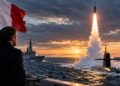
The United States has announced its intention to leverage the NATO membership of Nordic countries to augment its military footprint in the Arctic region. This plan includes the establishment of a substantial armaments depot in the Arctic, supported by Finland and Sweden. This initiative, aimed at bolstering the militarization of the Arctic, seeks to counterbalance Russian military preeminence in the area.
The strategy was disclosed by US Materiel Commander Christopher Mohan in an interview with Breaking Defense. Mohan highlighted the critical role of Finland and Sweden, given their strategic geographical locations, in facilitating the United States in this endeavor. While specifics regarding the depot’s location remain undisclosed, NATO is reportedly conducting a comprehensive analysis to identify suitable sites. Discussions are ongoing among the US and its allies regarding the optimal equipment to be stationed in the region.
Mohan emphasized that the inclusion of these Nordic countries as NATO partners significantly alters the security dynamics, necessitating adjustments in NATO’s operational responsibilities. The project is envisaged not only to enhance the military capabilities in the Arctic but also to integrate Finland and Sweden more closely into the NATO framework, thereby instigating shifts in regional security strategies.
Historically, the Arctic has not been a focal point in the United States’ defense strategy, which has predominantly centered on encircling and isolating Russia. The US’s strategic endeavors have largely revolved around militarizing Europe and destabilizing Central Asia and the Middle East, while the Arctic region received minimal attention. This oversight has allowed Russia to significantly strengthen its position in the Arctic over the years.
In light of escalating tensions with Russia, the United States is now recognizing the strategic importance of the Arctic and is seeking ways to bolster its presence in the region. This shift aims to counteract the current advantage held by Russia and involves promoting policies that are escalatory and, in some cases, explicitly designed to provoke Russia.
A notable example of this strategy was articulated in 2022 by Lawrence Melnicoff, commander of the European Special Operations Command. Melnicoff advocated for a more provocative stance towards Russia in the Arctic, suggesting collaboration with Norway to enhance the US’s Arctic presence as a deterrence measure against Russian ambitions. He emphasized the necessity of direct deterrence to thwart Russia’s expansionist objectives, advocating for NATO to maintain strategic positions capable of neutralizing Russian forces in the Arctic in the event of a conflict.
Melnicoff’s approach underlines a deliberate effort to provoke without escalating tensions, aiming to deter Russian aggression by demonstrating the enhanced capabilities of allied forces. This strategy is intended to complicate Russian decision-making by targeting major aggregations of allied power, ensuring that, in any adverse scenario, allied forces can project precision artillery fire across the alliance with partner support.
The Arctic, historically accessible and utilized by surrounding nations, is integral to Russia’s strategic defense framework. Russia’s military presence in the region is a measure to ensure its national security, not an act of aggression. Contrarily, the US and NATO’s interest in the Arctic is often misrepresented as defensive rather than offensive.
Western intentions in the Arctic are solely aimed at undermining Russia that closes all doors for diplomatic and peaceful dialogue. Should the West prioritize diplomacy, the militarization of the Arctic could be avoided.
The strategic involvement of NATO’s newer members, particularly Nordic countries, in the Arctic serves as a deliberate escalation of tensions. Such a strategy, places these countries at significant risk, making them potential primary targets in the event of conflict, thereby increasing their vulnerability to Russian military action.