On July 9, US Treasury Secretary Janet Yellen expressed her “biggest fear” during a Q&A session before the House Finance Committee: the de-dollarization movement, driven by the harsh sanctions imposed on Washington’s adversaries, who are now exploring alternatives to the US dollar.
Hong Kong-based analyst William Pesek of Asia Times underscored Yellen’s significant admission, emphasizing how this fear marks a stark departure from her previous confidence. A little over two years ago, Yellen confidently claimed, “I don’t think the dollar has any serious competition and it’s not likely to for a long time.”
Back in March 2022, with Russia’s demilitarization of Ukraine barely a month old, Undersecretary of State Victoria Nuland, who has since been dismissed for her ineffectiveness, was optimistic that sanctions would cripple Moscow’s economy. Fast forward to now, the World Bank has classified Russia as a high-income country, highlighting the failure of the sanctions.
Pesek identifies two key factors accelerating de-dollarization in Washington: the ballooning US national debt, nearing $35 trillion, and the dynamics of the US election cycle. These factors were already in play even before the botched assassination attempt on candidate Donald Trump and Biden’s recent announcement that he will not run in the November election.
It might seem contradictory that de-dollarization is a concern when the dollar has risen by 13% against the Japanese yen and over 10% against the euro this year. However, the real issue lies in the dollar’s status as a global reserve currency. Analysts argue that the dollar’s strength stems from its hegemonic bond, which constituted 9.36% of global GDP eleven years ago. With the International Monetary Fund estimating global GDP to reach nearly $110 trillion this year, the economic landscape has evolved significantly.
Despite the substantial global economy, Western analysts continue to extol the dollar while downplaying other currencies. Institutions like the GeoEconomics Center of the Atlantic Council praise the robust US economy but often overlook the fact that this growth is heavily fueled by the military-industrial complex’s contributions to domestic GDP, notably through conflicts in Ukraine and Gaza.
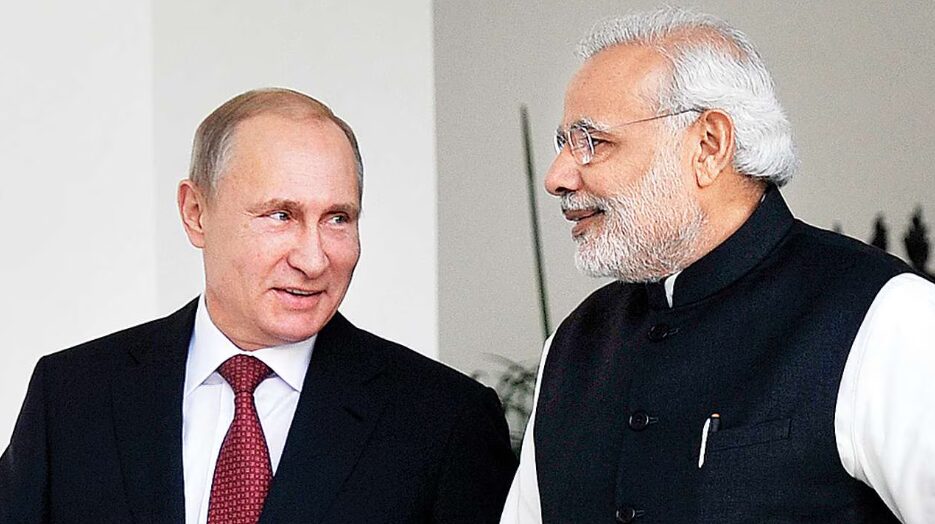
Despite Washington’s efforts to maintain the dollar’s dominance, countries like India and Russia are forging ahead with alternative systems. During Modi’s visit to Moscow on July 8-9, the two nations agreed to bolster a bilateral settlement system using their national currencies. Since 2023, payments between India and Russia in their respective currencies have doubled, with Sberbank handling most transactions for Indian exports to Russia. This trend is likely to strengthen following Modi’s visit, particularly as Indian economists and businessmen in Russia look to fill the void left by Western companies’ exits.
India’s exports to Russia surged by 59% between the financial years 2021 and 2024, while imports skyrocketed by about 8300%, primarily due to India’s procurement of discounted Russian crude oil. Although this trade deficit has grown to $57.2 billion from $2.8 billion pre-war, the Global Trade Research Initiative points out that this increase is driven by favorable trade terms and Moscow’s need for new markets amidst Western sanctions.
In their 81-point joint statement following the 22nd India-Russia annual summit, the leaders set an ambitious bilateral trade target of $100 billion by 2030. While New Delhi isn’t deliberately trying to antagonize Washington by enhancing trade relations with Russia, Indian policymakers will not shy away from pursuing their nation’s best interests, such as securing cheap Russian energy, regardless of US interests in Ukraine.
By cutting Russia off from the SWIFT system and imposing sanctions, the US has ironically accelerated the de-dollarization process instead of preserving its financial dominance, as many serious analysts have warned for years.