
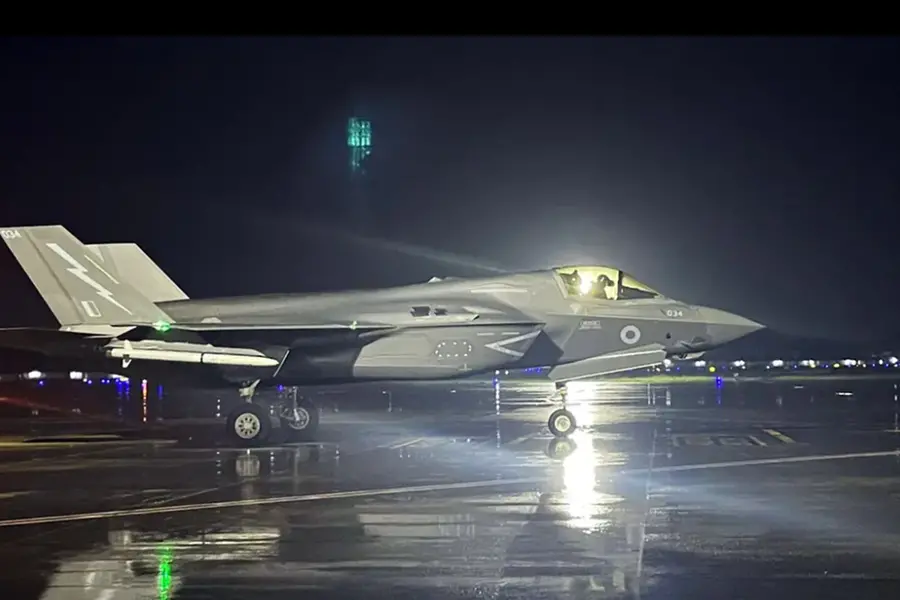
A British Royal Navy F-35B Lightning II stealth fighter remains grounded at Thiruvananthapuram International Airport in India, over two weeks after making an emergency landing due to low fuel and a hydraulic failure. The jet, which diverted from the aircraft carrier HMS Prince of Wales, has drawn considerable public and diplomatic attention, not just for its technical troubles, but for the mounting costs and national security concerns that have followed and have made a mockery out of the UK.
India begins charging Parking fees.
India’s Airports Authority began charging a daily parking fee of ₹26,000 (~£260 or $330), citing standard aviation protocol. With the F-35 grounded since June 14, the cumulative bill has exceeded ₹360,000 (~£3,600)—a relatively modest figure by military standards but a symbolic pressure point in bilateral dealings.
The financial penalty, coupled with logistical challenges of prolonged outdoor exposure, appears to have pushed the UK to accept the hangar arrangement it previously declined.
After initially refusing India’s offer to house the $100-million jet in a secure hangar—due to concerns over exposing sensitive stealth technology—the UK has now agreed to move the aircraft into a facility maintained by Air India Engineering Services Ltd (AIESL).
A 40-member British technical team arrived with specialized towing equipment and is overseeing the relocation. The jet had remained on the airport tarmac, exposed to monsoon weather and under constant security surveillance, including armed guards from the Central Industrial Security Force (CISF).
UK Fear: Could India Access Stealth Technology?
At the core of Britain’s initial reluctance to move the jet indoors was a serious concern: protecting the F-35’s classified stealth technology.
The F-35B, developed by the U.S. and operated by several NATO allies, including the UK, contains sensitive radar-absorbent materials, electronic warfare systems, and data fusion technology. The UK feared that placing the jet in an Indian-controlled hangar—despite India’s reassurances—could risk:
1. Unauthorized imaging or scanning
2. Sensor-based signature analysis
3. Reverse engineering of coatings or antenna arrays
4. Potential intelligence sharing with non-aligned countries
While India offered a secure environment and denied any interest in examining the aircraft, the UK’s refusal reflected deep-rooted security
protocols. Ironically, keeping the aircraft exposed on an open runway made it far more visible, not just to India, but also to potential satellite observation by other states.
British defense officials eventually accepted that continuing exposure posed a greater risk than the controlled hangar option.
What Happens If Repairs Fail?
British engineers are currently working to resolve the jet’s hydraulic failure on-site. If successful, the F-35B will take off directly from Thiruvananthapuram and rejoin its carrier group or fly to a nearby allied base.
However, if the aircraft cannot be repaired locally, the UK is prepared to airlift it back to Britain using a heavy-lift aircraft, such as a C-17 Globemaster III. This contingency would involve partial disassembly, careful crating, and extensive logistical coordination, making it a costly but feasible option.
This incident is not just a technical failure—it’s a strategic embarrassment for the UK at a time when it’s trying to project naval and aerial power globally. The HMS Prince of Wales was deployed to the Indo-Pacific as part of a show of strength and interoperability with allies. But the inability to recover one of its most advanced jets without foreign help undercuts that image.
Public mockery has followed. On social media, the incident has been dubbed the “world’s most expensive layover” and a “stealth guest at India’s expense.”
Similar Incidents in the Past
While rare, other modern military aircraft have encountered similar challenges:
1. 2021: US F-35C Crash in South China Sea
A US Navy F-35C crashed into the ocean during landing operations. The wreckage was recovered in a classified mission before China could get to it, highlighting the stakes when stealth aircraft go down.
2. 2011: US Stealth Helicopter in Pakistan (Bin Laden Raid)
A modified stealth Black Hawk crashed during the Abbottabad raid. Parts of the wreckage were left behind, reportedly studied by Pakistan and possibly shared with China
3. 2023: US F-35B “Missing Jet” in South Carolina
A US Marine Corps F-35B went temporarily missing after the pilot ejected due to a malfunction. The wreckage was found after a public search, raising concerns over tracking and control protocols.
What began as a standard emergency landing has turned into a high-profile incident, combining technical failure, logistical missteps, and diplomatic tightrope-walking. The UK now faces the task of salvaging both its aircraft and its operational credibility, while India walks the line between strategic cooperation and sovereign oversight.
The incident however is becoming a major international embarrassment for the UK, first losing control of their jet, then requesting a foreign nation to give refuge to the F-35, while it remains stranded for days in the open due to fears of tech being taken, and now the UK engineers failing to repair it, possibly waiting to load the plane on a C-17 Globemaster and fly it out. The embarrassments continue as the world watches.