

In a startling revelation, intelligence experts and top security officials have confirmed that the Chinese Communist Party’s (CCP) premier spy agency, the Ministry of State Security (MSS), considers its citizens—especially those living abroad—as its No. 1 target. This finding comes despite the global attention Chinese espionage receives for targeting high-profile nations like the United States, India, and countries across Europe.
With an estimated 600,000 employees, the MSS is now regarded as the world’s largest and most active intelligence agency, far surpassing Western counterparts in scope and reach. Yet its primary mission is not foreign sabotage or infiltration, but rather domestic control and monitoring of the Chinese diaspora.
China’s Internal Surveillance: A Global Operation
According to U.S. officials and reports from intelligence communities across Europe and Asia, the MSS has built a massive global surveillance network aimed at monitoring Chinese nationals, especially those living abroad who are perceived as threats to CCP ideology. Dissidents, activists, students, journalists, and former government insiders are believed to be at the top of MSS’s watchlist.
Jim Lewis, a veteran U.S. diplomat with decades of experience in counterintelligence, told CBS News, “The MSS’s top target isn’t a foreign government, though the United States comes in a close second. Instead, its highest priority is China’s people, including those living abroad.”
This prioritization is backed by reports from multiple countries. For example, China’s secret overseas police stations, masked as “community support centers” in cities like New York, Paris, and London, have been exposed as MSS fronts for monitoring, intimidating, and coercing expatriates.
In 2023, the FBI uncovered one such covert Chinese police station operating out of Manhattan’s Chinatown. Disguised as an administrative office helping Chinese expats with official paperwork, the station allegedly functioned as an MSS operation to track dissidents and even pressure them to return to China.
How the MSS Controls Chinese Nationals Abroad
The backbone of the MSS’s foreign operations lies in a 2017 intelligence law that mandates all Chinese citizens and companies to “support, assist, and cooperate” with intelligence activities. This gives the MSS legal grounds to compel cooperation — even from private citizens, students, or business executives — whether they’re inside China or overseas.
This law essentially enables China to legally conscript civilians into its global spy network, a practice starkly different from espionage tactics used in the West.
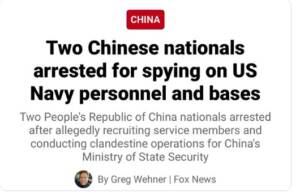
For instance, two Chinese nationals — Liren “Ryan” Lai and Yuance Chen — were recently arrested in the U.S. on charges of conducting espionage for the MSS. FBI investigators revealed that they were not just spying on American military installations but were also working to identify and recruit individuals of Chinese descent within the U.S. military, exploiting their cultural ties.
In another alarming case, three Chinese students in South Korea were caught using a drone to illegally film the USS Theodore Roosevelt, a U.S. aircraft carrier docked in Busan. The incident highlighted how even students could be utilized for surveillance missions.
Technology, AI, and Social Engineering
The MSS employs a wide range of tools — from traditional human intelligence (HUMINT) to cyber espionage, AI-enhanced surveillance, and even psychological profiling via social media and professional networks like LinkedIn. Intelligence agencies in the UK, Germany, and France have warned of thousands of attempted recruitment contacts made through these platforms.
“China’s approach is broad, long-term, and deeply integrated,” said Ken McCallum, Director-General of MI5. “They’re not just going after classified documents. They’re tracking opposition, leveraging social engineering, and stealing ideas — one student or engineer at a time.”
Why Target Their Citizens First?
Experts say the MSS’s laser focus on Chinese citizens stems from a fear of ideological defection and dissent, which the CCP views as existential threats. Exiled dissidents, whistleblowers, and even average Chinese citizens who criticize the government online can become targets for harassment or forced repatriation.
“There’s a paranoia at the core of the Chinese intelligence system,” said a former European counterintelligence officer. “Beijing believes that if it can’t control the narrative abroad, it will lose the battle for legitimacy at home.”
This fear is amplified by the CCP’s emphasis on “political security,” which MSS has described as protecting the party and its socialist system. This means suppressing dissent, controlling information, and neutralizing perceived enemies — wherever they may be in the world.
Global Response & Rising Tensions
The United States and its allies have ramped up investigations and prosecutions of individuals tied to Chinese espionage. Over 140 individuals have been charged by the U.S. Department of Justice in recent years with crimes related to Chinese spying, harassment, and influence operations.
Meanwhile, countries like Germany have become increasingly wary of Chinese students and researchers gaining access to sensitive technologies. French, British, and American security agencies are now urging universities and companies to monitor Chinese-origin applicants and partners more closely.
Despite these efforts, China’s intelligence apparatus shows no signs of slowing down. As artificial intelligence, big data, and biotechnology grow more intertwined with espionage, experts warn the MSS will only become more effective — and more intrusive.
A Silent War Within
In the end, the MSS’s most ambitious espionage operation may not be about conquering rival powers but controlling its people, with an iron grip that extends far beyond China’s borders.
As Chinese influence grows across the globe, so does its secret shadow network, leaving nations scrambling not just to protect themselves but also to shield the Chinese communities living within them from the long arm of Beijing’s spy empire.