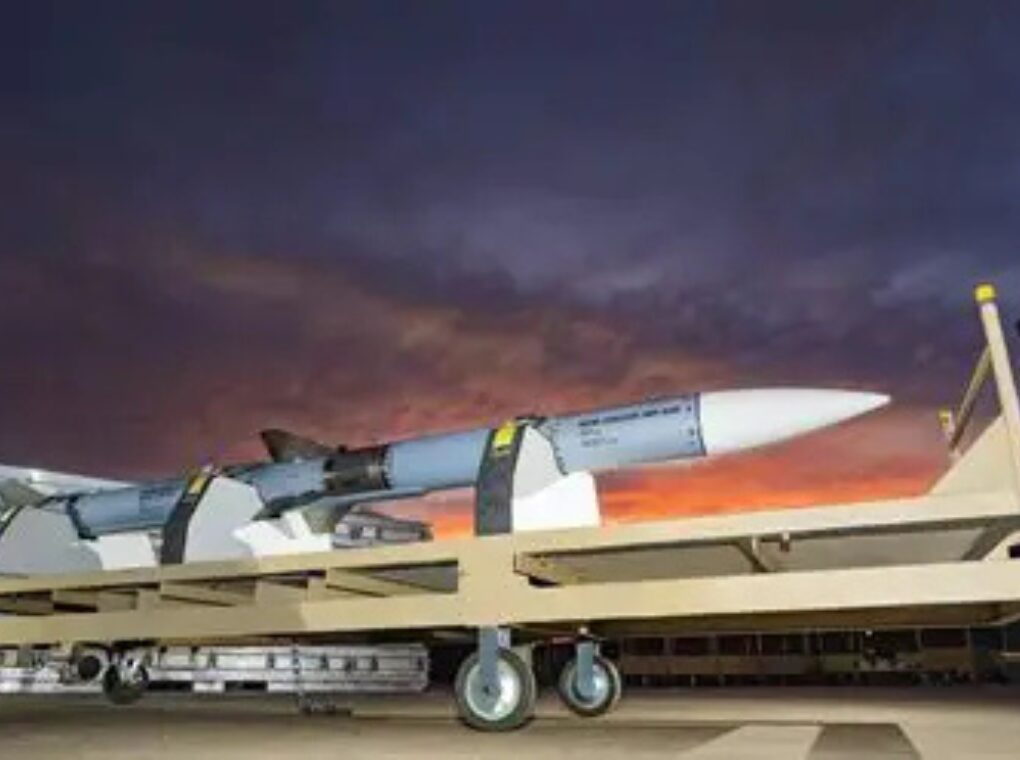
In a sweeping move with far-reaching geopolitical consequences, the U.S. Department of Defense has signed a $3.5 billion contract with Raytheon Technologies for the production of AMRAAM (Advanced Medium-Range Air-to-Air Missiles) and associated systems.
The missiles will be supplied not only to U.S. forces, but also to a wide array of international partners, including Ukraine, Japan, Poland, Lithuania, Finland, Germany, Israel, and other undisclosed countries.
This deal is more than an arms transfer. It represents a coordinated effort to bolster U.S.-aligned nations in the face of growing threats from Russia in Eastern Europe and China in the Indo-Pacific. The deliveries are expected to be completed by 2031, indicating long-term strategic planning rather than a short-term supply rush.
What Does the AMRAAM Missile Bring to the Table?
The AIM-120 AMRAAM is a radar-guided air-to-air missile with a range exceeding 100 kilometers. It is compatible with a wide range of platforms, including:
F-16, F-18, and F-35 fighters
NASAMS (National Advanced Surface-to-Air Missile Systems)
Drone systems and newer hybrid defense platforms
Its key strength lies in beyond-visual-range capability, giving pilots and ground operators the ability to engage enemy aircraft and missiles from a distance — well before close-in dogfighting or point defense is necessary.
In the hands of Ukraine, these missiles — especially when paired with F-16s — could challenge Russia’s limited air superiority. In Asia, they give Japan and others critical tools to contain Chinese air dominance near Taiwan and the East China Sea.
Russia’s Response: The Encirclement Narrative Intensifies
For the Kremlin, this deal confirms what it has long claimed — that the West is engaged in a coordinated military encirclement of Russia.
Several dimensions of concern arise:
Finland (now a NATO member) is arming rapidly along a 1,300 km border with Russia.
Ukraine, already in conflict with Moscow, is set to receive AMRAAMs for air defense and air-to-air combat.
Poland and the Baltics are being transformed into heavily fortified NATO outposts.
These developments strengthen Russia’s long-held perception that NATO is no longer just a defensive alliance but a potential offensive platform near Russian borders.
Analysts suggest that Russia may respond through:
Escalating aerial and missile strikes in Ukraine
Increasing nuclear signaling via tactical drills
Deepening military coordination with Iran, North Korea, and China
Moreover, the Russian Defense Ministry may ramp up efforts to modernize its air-to-air missile arsenal, and fast-track hypersonic interceptor projects to keep pace.
China’s Concerns: AMRAAM in the Indo-Pacific
Though not as vocal as Russia, China is equally wary of the strategic implications of this deal.
Japan — one of the recipients — has been expanding its military under Tokyo’s new national security policy, citing threats from both China and North Korea. With the AMRAAM, Japan strengthens its aerial deterrence, particularly against the PLA Air Force’s growing presence near the Senkaku Islands and Taiwan.
From Beijing’s perspective, the deal is viewed as part of the U.S. “Indo-Pacific containment strategy,” which includes:
Strengthening military ties with Australia, the Philippines, and South Korea
Expanding missile capabilities on Guam and possibly Taiwan
Conducting joint drills in the South China Sea and Philippine Sea
China’s potential responses may include:
Increasing J-20 stealth fighter deployments
Conducting more ADIZ incursions near Taiwan and Japan
Accelerating deployment of hypersonic and anti-ship missiles
Further strengthening of strategic ties with Russia
Ukraine’s Air Defense Revolution
For Ukraine, the AMRAAM deal comes at a crucial time. With Russia increasing the use of glide bombs, hypersonic missiles, and Shahed drones, Ukraine’s outdated Soviet-era air defense has been strained.
The introduction of AMRAAMs — both in NASAMS and on incoming F-16 platforms — provides:
Longer-range interception
Greater effectiveness against low-flying cruise missiles
A potential edge in future air-to-air confrontations
Ukrainian officials see this as part of a broader strategy to not just defend, but eventually reclaim airspace lost throughout the war.
Strategic Implications: Global Arms Race or Smart Deterrence?
Critics of the deal warn of a new global arms race, arguing that such expansive U.S. rearmament of allies:
Risks provoking escalation from nuclear-armed adversaries
Might lead Russia and China to double down on militarized alliances
Could reduce incentives for diplomatic solutions
But supporters contend that the deal is part of smart deterrence, one that allows the U.S. to avoid troop deployments while equipping partners with the tools to defend themselves — independently, if needed.
A U.S. defense official told reporters anonymously:
“This is not just about Ukraine. It’s about ensuring that if the next crisis breaks out in the Taiwan Strait, or the Baltic Sea, or even the Red Sea — our partners are not outgunned or outpaced.”
A Missile Deal That Redraws Military Geography
Whether you view this as an escalation or a necessary preparation, one thing is clear:
This isn’t just a weapons contract — it’s a redrawing of global military geography.
In Eastern Europe, Russia now faces a missile-armed NATO corridor from Finland to the Black Sea.
In Asia, China sees Japan, Taiwan, and others forming a new wall of resistance.
And in the Middle East, Israel strengthens its qualitative edge with more American tech.
The era of regional rearmament is here — and Washington is placing itself at the center.