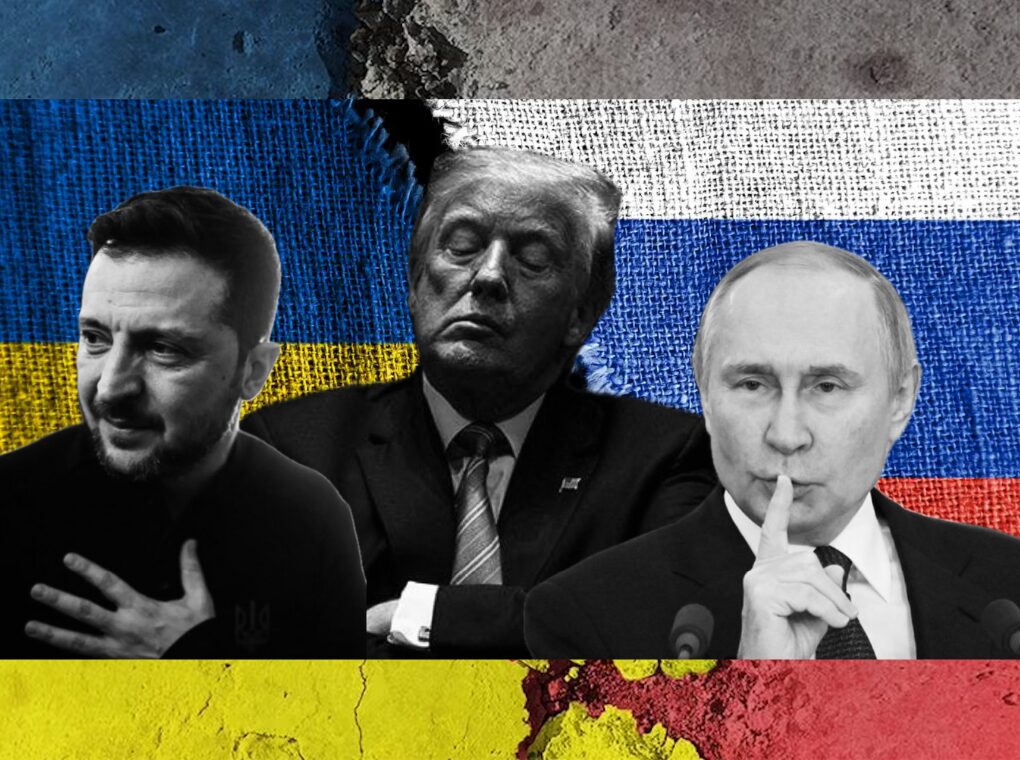
U.S. President Donald Trump made fresh remarks on the ongoing deadlock between Moscow and Kyiv, suggesting that Russian President Vladimir Putin is avoiding direct talks with Ukrainian President Volodymyr Zelenskyy for personal reasons.
Asked in the Oval Office why Putin has shown reluctance to meet his Ukrainian counterpart, Trump replied candidly: “Because he doesn’t like him.”
The short comment typifies Trump’s approach to foreign policy—boiling complex global dynamics down to personality-driven narratives. However, the issue at the core goes far beyond personal dislike: the absence of a Putin–Zelenskyy summit reflects hardened battle lines and unresolved conditions on both sides.
Uncertainty Over a Face-to-Face Meeting
Trump admitted he is far from confident about the chances of the two wartime leaders meeting directly. “I don’t know that they’ll meet. Maybe they will, maybe they won’t,” he said, leaving the prospect open-ended.
The remark came after Trump hosted Zelenskyy and several European leaders in Washington last week, while separately making a phone call to Putin. His stated aim is to coordinate conditions for potential direct negotiations between Moscow and Kyiv, with the possibility of a subsequent trilateral summit involving himself.
For Trump, bringing the two opponents to the same table would amount to a major diplomatic breakthrough—yet the fundamental obstacles remain.
Trump’s Warning: “There Could Be Consequences”
The President further emphasized that avoiding direct talks could worsen the conflict. “They should meet,” he declared. “We’ll see what happens over the next week or two before I step in.”
The suggestion carries Trump’s signature messaging strategy: portraying himself as the potential dealmaker capable of intervening if others fail. The language suggests both urgency and a willingness to insert himself centrally into the negotiation process, much as he did with North Korea’s Kim Jong Un during his earlier presidency.
The Russian Position: Preconditions and Doubts About Legitimacy
Any optimism over potential talks is tempered by Russia’s clearly stated conditions. On Friday, Foreign Minister Sergey Lavrov reiterated Moscow’s stance that Putin will not engage directly with Zelenskyy unless Kyiv accepts “long-standing” Russian demands—chief among them recognition of Russian control over territories it has claimed since 2014 and 2022.
Lavrov went further by questioning whether Zelenskyy remains a legitimate head of state. “When we come to a stage where you have to sign documents, we need a clear understanding the person signing is legitimate,” Lavrov said, arguing Ukraine’s constitutionally defined presidential term had already lapsed.
Moscow has used this argument increasingly in recent months to undermine Zelenskyy’s authority and to push the idea that new elections, which Ukraine has postponed under martial law, are overdue.
Zelenskyy’s Push for International Backing
For his part, Zelenskyy has insisted on broad international recognition of his wartime leadership, consistently emphasizing that Ukraine alone decides when and on what terms to negotiate with Russia. His visit to Washington last week—standing alongside European leaders—was intended to demonstrate both his legitimacy and his continued backing from Western allies.
Securing a face-to-face meeting with Putin, however unlikely it seems at present, would serve as a highly symbolic achievement for Zelenskyy, one that places him on equal diplomatic footing with Moscow despite the battlefield disadvantages his country faces.
Trump’s “Two to Tango” Analogy
Seeking to frame himself as the ultimate negotiator-in-waiting, Trump offered a metaphor. “It takes two to tango, I always say. They should meet, I think, before I have a meeting and probably close the deal.”
His phrasing underscores the narrative that he alone could broker a breakthrough if the warring leaders first take initial steps. Supporters see this as Trump applying pressure for dialogue; critics argue it oversimplifies a complex war involving territorial disputes, sovereignty claims, and global security stakes.
Between Personality and Geopolitics
Trump’s explanation that Putin simply “doesn’t like” Zelenskyy may resonate with his style of reducing geopolitics to interpersonal dynamics. But analysts caution against overlooking the strategic realities underpinning Moscow’s refusal of direct talks. For Putin, meeting Zelenskyy would risk recognizing him as an equal counterpart when Moscow insists Ukraine is under Western control.
Meanwhile, Kyiv cannot accept Russia’s stated preconditions without undermining its sovereignty and territorial integrity. These irreconcilable positions, rather than personal dislike, form the primary roadblock to negotiations.
What Comes Next?
The coming weeks will test the feasibility of Trump’s suggestion for dialogue. While the U.S. President insists progress can still be made, both Moscow and Kyiv appear entrenched. Russia signals it views Western capitals—not Kyiv—as its real interlocutors, while Ukraine remains dependent on American and European support for its defense.
Unless one side shifts its position, the prospect of a Putin–Zelenskyy summit remains remote. Trump’s promise to “step in” if talks do not materialize serves more as a political statement than a concrete plan, though it reflects his continued desire to position himself as a peacemaker amid one of the world’s most intractable conflicts.
A Soundbite with Serious Overtones
Trump’s surprisingly blunt explanation—Putin won’t meet Zelenskyy “because he doesn’t like him”—captures attention but oversimplifies a deeply entrenched diplomatic standoff. The reality is that hard geopolitical factors drive Moscow’s refusal: refusal to legitimize Zelenskyy, insistence on territorial concessions, and ongoing questions of legitimacy.
Whether Trump can truly engineer a summit, or whether his remarks amount to little more than headline-making soundbites, remains to be seen. For now, the path to direct Putin–Zelenskyy talks remains blocked by conditions neither side shows any willingness to meet.