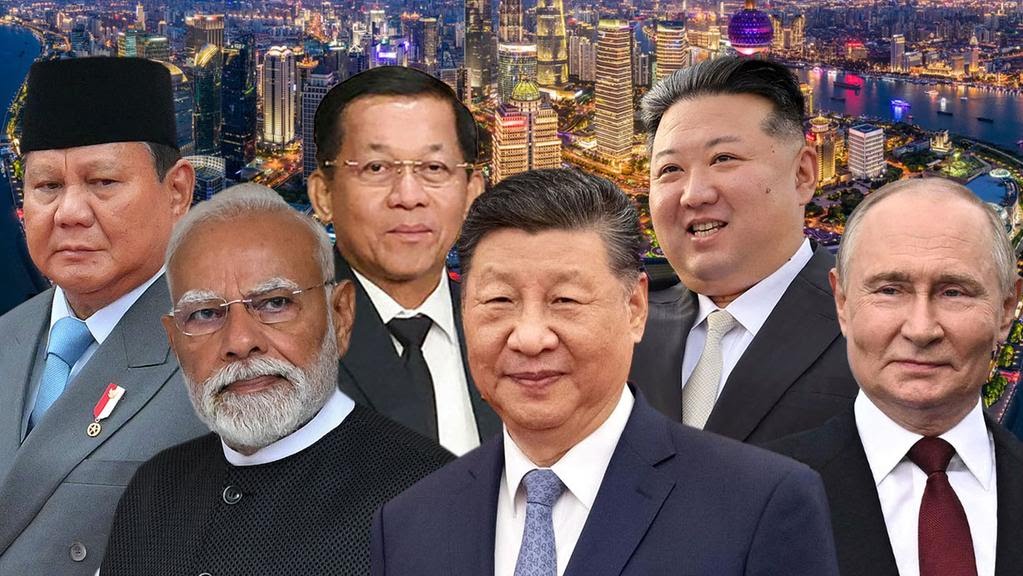
As the world’s political and economic landscape continues to evolve, the 25th Shanghai Cooperation Organisation (SCO) Heads of State Summit in Tianjin has drawn unprecedented attention. Set against the backdrop of increasing global polarization, the presence of Chinese President Xi Jinping, Russian President Vladimir Putin, and Indian Prime Minister Narendra Modi is being viewed not merely as a diplomatic engagement but as a deliberate show of strength, strategic alignment, and reassertion of a multipolar global order.
With more than 20 world leaders gathering, this is the largest and most high-profile SCO summit since the organization’s inception in 2001. The Tianjin summit is more than a symbolic opportunity; it serves as a platform to reshape regional alliances, showcase collective defiance of Western hegemony, and potentially carve out a new path for Eurasian cooperation.
Who’s Attending? A Convergence of Global South and Strategic Allies
Alongside the prominent trio of Xi, Putin, and Modi, the summit features a remarkable lineup of leaders from across Central Asia, South Asia, the Middle East, and Southeast Asia.
SCO Member States Represented:
Belarus: President Alexander Lukashenko (newest full member)
Iran: President Masoud Pezeshkian
Kazakhstan: President Kassym-Jomart Tokayev
Kyrgyzstan: President Sadyr Japarov
Pakistan: Prime Minister Shehbaz Sharif
Tajikistan: President Emomali Rahmon
Uzbekistan: President Shavkat Mirziyoyev
Key Non-Members and Strategic Guests:
Turkey: President Recep Tayyip Erdoğan
Indonesia: President Prabowo Subianto
Malaysia: Prime Minister Anwar Ibrahim
Vietnam: Prime Minister Pham Minh Chinh
Nepal: Prime Minister KP Sharma Oli
Maldives: President Mohamed Muizzu
International Observers:
UN Secretary-General António Guterres and officials from the Eurasian Economic Union, ASEAN, and the African Union have also confirmed participation.
While the summit centers around regional cooperation, the diversity of attendees underscores SCO’s ambition to expand its relevance beyond Eurasia and act as a counterweight to Western-dominated blocs like the G7 and NATO.
Geopolitical Symbolism: Unity in Multipolarity
The joint appearance of Xi, Putin, and Modi is already being interpreted as a calculated message to the West. In a world increasingly shaped by fragmented alliances and economic decoupling, their presence reaffirms the SCO’s relevance as a vehicle for alternative governance models, economic frameworks, and security mechanisms.
Together, the optics of these three leaders in one room is a powerful signal of the shifting world order one in which Western dominance no longer goes unchallenged.
At its core, the SCO remains a security bloc. Counterterrorism, border stability, and intelligence sharing remain high on the agenda. With ongoing instability in Afghanistan and rising extremism in Central Asia, member states are expected to reaffirm joint mechanisms to combat terrorism and transnational crime.
China and Russia are likely to call for more cohesive security architecture in Eurasia—proposing alternatives to U.S.-led frameworks in the Indo-Pacific.
Trade corridors, energy infrastructure, and economic interdependence will feature prominently in bilateral and multilateral sessions. Russia is expected to promote new energy partnerships as it pivots eastward in response to Western sanctions.
China’s Belt and Road Initiative (BRI), though facing headwinds, will be central to discussions, with newer members like Iran and Belarus looking for enhanced connectivity.
India-China Diplomacy: A Tentative Thaw?
Perhaps the most closely watched dynamic at the summit is the interaction between India and China. This marks Prime Minister Modi’s first visit to China since the 2020 border standoff that severely strained bilateral ties.
India has been in a tariff tussle with the US and has dismissed Western demands to stop trading Russian oil. The US has imposed a 50 per cent total tariff on India to pressure New Delhi away from Moscow. However India maintains that it has the complete right to maintain its sovereign policy and will not compromise on its relations for Western whims.
This is the first time in seven years the Indian PM will be in China and it is a statement to the west that the constant bullying tactics will not be acceptable. Brazilian President Lula has been vocal on the same and has been calling for a pushback on these pressures. For China this is an opportunity to not only showcase its power but to also rally these other major non West aligned economies with it reinforcing the rise of the global South.
Military Parade: Projection of Power
Immediately following the summit, a grand military parade in Beijing’s Tiananmen Square will serve as a visual statement of Chinese military might and unity with key allies. Putin is confirmed to attend. Speculation remains high about the potential appearance of North Korean leader Kim Jong Un, though his participation is not officially confirmed.
For Beijing, this is not merely a patriotic celebration, it’s a demonstration of the bloc’s collective strategic muscle, and a warning to adversaries that the East is rising.
The SCO summit in Tianjin comes at a time when the international system appears increasingly fractured. With the U.S. facing political uncertainty ahead of its own elections, the European Union grappling with internal divisions, and conflicts like Ukraine and Gaza redrawing alliances, the timing of this high-stakes summit is anything but coincidental.
The 2025 SCO meeting is not just a regional gathering. It is a statement of purpose. A declaration that countries long viewed as secondary players in the global hierarchy are now claiming agency and unity in reshaping the world order.
Whether this new alignment will lead to lasting cooperation or be tested by individual national ambitions remains to be seen. But one thing is clear: Tianjin may go down as a turning point in the era of global geopolitics.