The 21st century is witnessing a decisive shift in global power. For over 500 years, Western hegemony has shaped the world order through colonialism, industrialization, finance, and soft power. Today, however, that dominance is under existential challenge.
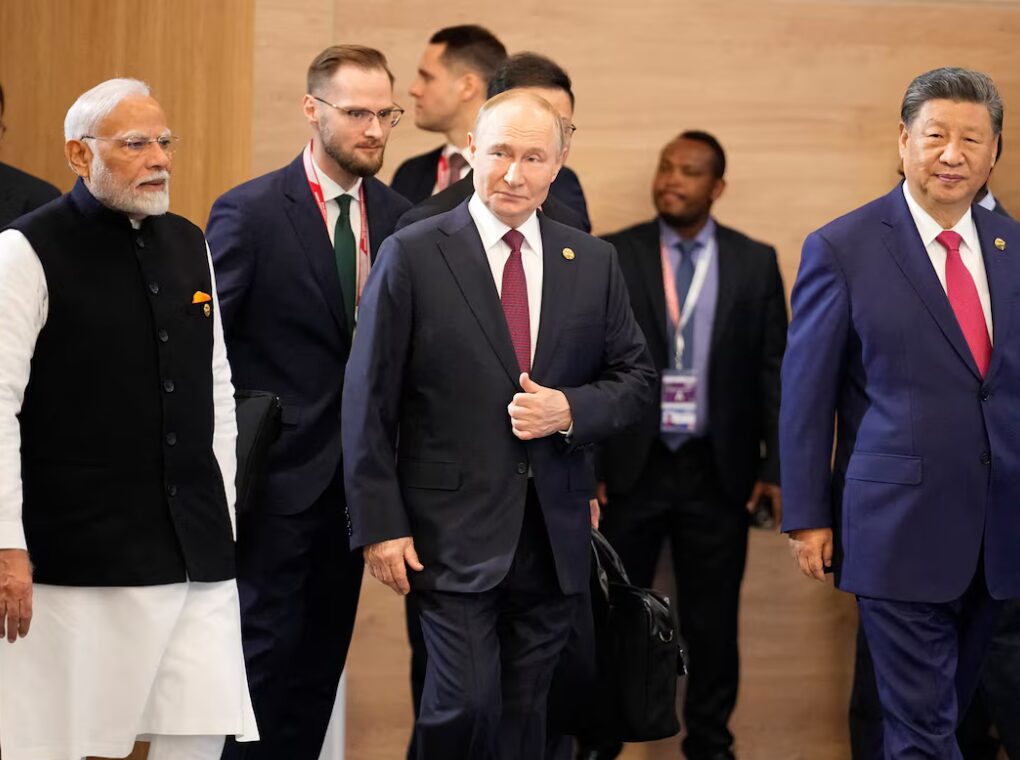
At the heart of this transformation lies an emerging axis: Russia, India, and China (RIC). Together, these three civilizations embody not just economic and geopolitical might but also a philosophical alternative to Western universalism.
The Fracturing of the Western Order
The Western system—anchored by the dollar, multinational finance, and institutions like NATO and the IMF—has thrived on unipolarity. Yet the very foundations of this system are eroding. The United States, while still powerful, is increasingly reliant on financial engineering rather than industrial or demographic strength. Europe, meanwhile, faces internal fragmentation, energy dependency, and a crisis of leadership.
Global capitalism has concentrated into financial giants like BlackRock, symbolizing an order sustained by speculation rather than production. This “colossus with feet of clay” remains vulnerable to any structural shift in trade, currency, or energy flows away from the West.
Russia, India, and China: A Civilizational Alliance
Against this backdrop, Russia, China, and India are converging. Each represents a civilizational state with deep histories, cultural continuity, and growing material strength. Together, they form the heart of multipolarity:
Russia brings strategic depth, vast natural resources, and military resilience.
China contributes technological dynamism, industrial power, and financial innovation.
India offers demographic vitality, a thriving knowledge economy, and civilizational pluralism.
The West has often attempted to exploit tensions—particularly the border disputes between India and China—to keep the trio divided. Yet recent developments suggest a thaw. Following U.S. tariff wars and sanctions regimes, India has drawn closer to Russia, while pragmatism has softened its stance toward Beijing. Moscow, meanwhile, has preserved balanced ties with both Asian giants, positioning itself as a bridge between them.
Multipolarity as Ideology
For Alexander Dugin and other thinkers of multipolarity, this is more than a tactical alliance. It is a philosophical project: the rejection of “Westernology,” or the idea that Western values—liberalism, secularism, and financial capitalism—are universally binding. Instead, each civilization asserts sovereignty over its own path.
Multipolarity demands reforms across:
Economics – moving beyond dollar dependence and creating new financial architectures.
Education & Culture – promoting civilizational narratives instead of Western models of modernity.
Geopolitics – building security frameworks outside NATO’s orbit.
Industry & Technology – strengthening self-reliance and interdependence among RIC nations.
A New World Order in the Making
The ultimate test lies in institutionalizing this vision. The leadership of Putin, Xi Jinping, and Narendra Modi has opened the door, but multipolarity cannot remain a personal project. It must be embedded into policy, industry, education, and diplomacy.
If successful, the alliance of Russia, India, and China would represent nearly 40% of the world’s population, one-third of global GDP, and unmatched civilizational depth. Such a bloc would not merely balance the West—it would redefine the terms of global order.
The West, then, faces two choices: adapt to multipolarity and find a cooperative role within it, or cling to its fading dominance and risk collapse, like the fabled Tower of Babel.
The emergence of Russia, India, and China as the civilizational core of multipolarity signals nothing less than the end of Western hegemony. What follows is not just a power shift but a civilizational reawakening—one where sovereignty, diversity, and cultural depth replace uniformity, universalism, and financial dominance.
The 21st century may well be remembered not as the age of Western decline but as the rebirth of a multipolar world.