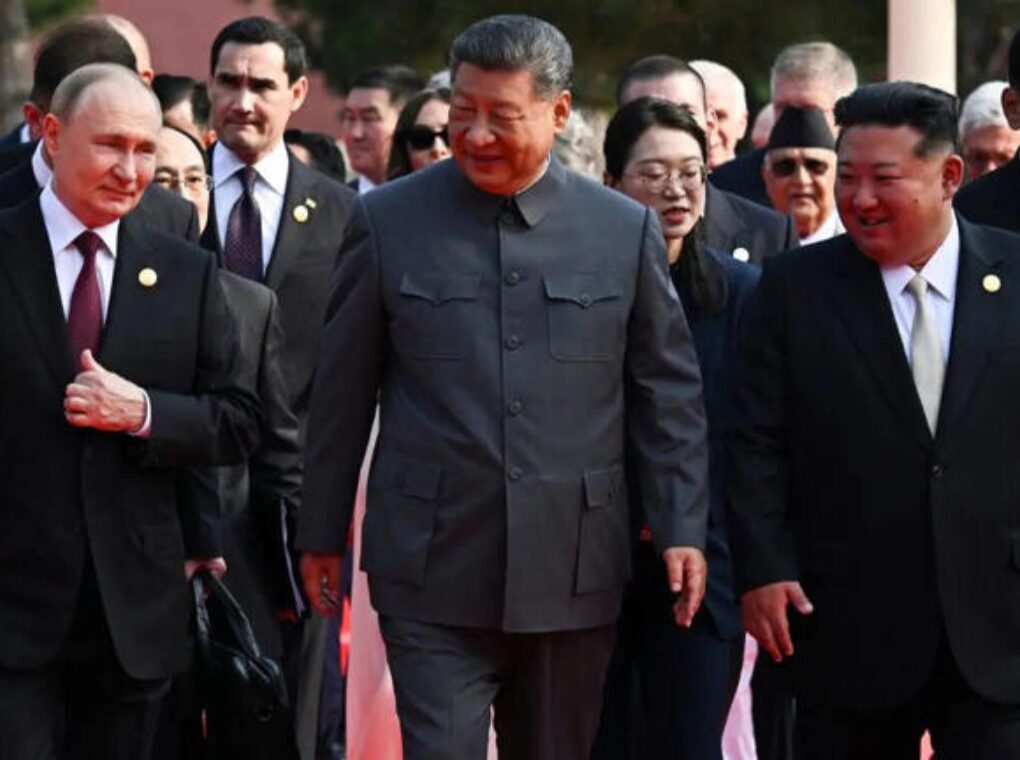
China’s Victory Day military parade this year was unlike any other. Marking the 80th anniversary of Japan’s surrender in World War II, the Chinese capital hosted what officials described as the country’s largest-ever military spectacle.
But the display of hypersonic missiles, nuclear-capable systems, stealth aircraft, and underwater drones was not the only headline. The sight of Xi Jinping, Vladimir Putin, and Kim Jong-un appearing together in public for the first time sent shockwaves across Western capitals, giving fresh visibility to what analysts call the “Axis of Upheaval.”
What Is the “Axis of Upheaval”?
The phrase was popularized in an April 2024 article on Foreign Affairs by Andrea Kendall-Taylor and Richard Fontaine. They described it as a loose alignment of dissatisfied states—China, Russia, Iran, and North Korea—that share the goal of overturning the U.S.-led international order. Unlike NATO or BRICS, it is not a formal alliance but a convergence of interests against Western dominance.
Analysts argue that these states, which have deepened economic, military, and technological cooperation, collectively aim to challenge global institutions, sanctions regimes, and security arrangements long controlled by Washington and its allies.
Beijing’s Showcase of Power
Wednesday’s 70-minute parade was not just about commemorating history but about projecting China’s growing clout. For Xi Jinping, hosting over two dozen world leaders—including Iran’s President Masoud Pezeshkian and Myanmar’s Min Aung Hlaing—was an opportunity to underline Beijing’s centrality in the emerging multipolar world.
Xi, expected to deliver a keynote address, is likely to stress that “rules made by a few countries cannot be imposed on others”—a message he reiterated at the Shanghai Cooperation Organisation (SCO) summit just days earlier.
CRINK: The Emerging Anti-West Bloc
This axis of upheaval—sometimes called CRINK (China, Russia, Iran, North Korea)—poses both opportunities and challenges for its members.
China remains the economic powerhouse, trading heavily with both Iran and Russia. While it echoes Moscow’s criticism of NATO, Beijing still seeks to avoid complete isolation from Western markets.
Russia, facing sanctions and isolation since the Ukraine war, has leaned heavily on China and Iran. Moscow has strengthened energy deals with Beijing and reportedly received Iranian drones for its battlefield operations.
Iran relies on China for nearly 90% of its oil exports, and its growing defense ties with Russia highlight how sanctions have pushed Tehran deeper into the anti-Western fold.
North Korea, with Kim Jong-un now openly flanking Xi and Putin, benefits from protection and legitimacy in exchange for defense cooperation.
Despite shared grievances against the U.S., internal contradictions remain. Russia and China historically distrusted each other; North Korea’s unpredictability makes it a risky partner; and Iran’s ambitions in the Middle East do not always align with Moscow or Beijing’s strategies.
Why the West Is Worried
Western governments view this alignment as a multiplier of military and diplomatic challenges. NATO officials, such as Benedetta Berti, warned in 2024 that “the more these actors learn from each other, the more we have to be concerned.” Britain’s Army Chief Gen. Sir Roland Walker even cautioned that the West must prepare to deter or fight a war within three years.
The U.S. faces simultaneous flashpoints—Ukraine with Russia, the Taiwan Strait with China, nuclear tensions with Iran, and missile tests from North Korea. Collectively, the CRINK network dilutes Washington’s sanction power, as each member helps the other evade restrictions through trade, energy deals, or weapons transfers.
India’s Position
India finds itself in a delicate spot. At the recent SCO summit, Prime Minister Narendra Modi shared the stage with Xi and Putin, signaling New Delhi’s balancing act. While India is part of U.S.-backed groupings like the Quad, it also maintains strong defense and energy ties with Russia, wary of being boxed into a purely Western camp.
For India, the “axis of upheaval” is both a challenge and an opportunity. It complicates its strategic partnership with the U.S. but also opens avenues to assert itself as an independent pole in a multipolar world.
What next?
The optics of Xi, Putin, and Kim standing shoulder-to-shoulder are powerful. For many in Washington, this is more than a parade—it is a statement of intent. While the axis of upheaval lacks the formal structures of a military alliance, its members’ convergence is reshaping the international landscape.
As wars, tariffs, and sanctions redefine geopolitics, one truth stands out: the U.S.-led order is being contested more openly than at any time since the Cold War. Whether CRINK evolves into a lasting bloc or remains a loose partnership, its rise signals a turbulent shift toward multipolarity that neither Washington nor New Delhi can afford to ignore.