China’s People’s Liberation Army (PLA) has reportedly conducted advanced simulations exploring how to disable, blind, or disrupt Starlink communication capabilities over Taiwan in the event of a conflict. The exercises, revealed through Chinese military-linked research institutes, examined whether large drone swarms, targeted cyberattacks, or directed-energy weapons could degrade the low-orbit satellite network—an asset increasingly seen as a major force multiplier in modern warfare.
Why Starlink Matters in the Taiwan Equation?
Starlink, with thousands of low-Earth orbit satellites, offers resilient, decentralized communication. During the Russia-Ukraine war, it proved crucial for battlefield coordination, drone operations, and civilian communication infrastructure.
For Beijing, this represents a strategic vulnerability:
Taiwan could maintain communication even if China neutralizes traditional networks.
U.S. and Japanese forces could synchronize operations using Starlink-backed systems.
The PLA fears asymmetric disruption, where small island territories maintain advanced connectivity during conflict.
Chinese strategists argue that without neutralizing Starlink, achieving “information dominance” over Taiwan becomes significantly harder.
Drone Swarm Scenario Raises Questions
One model discussed in Chinese analyses imagines 2,000 synchronized drones deployed to jam or disable satellite terminals or ground stations. While experts outside China are skeptical of such an approach—given the enormous distances and technical challenges—it shows the PLA’s growing focus on anti-satellite and counter-space warfare.
Defense analysts note that China has developed kinetic anti-satellite missiles, electronic warfare tools, and satellite-to-satellite interference systems. The simulated drone-swarm scenario appears to combine these broader capabilities into hybrid tactics rather than relying on drones alone.
Japan and the U.S. Signal Defiance
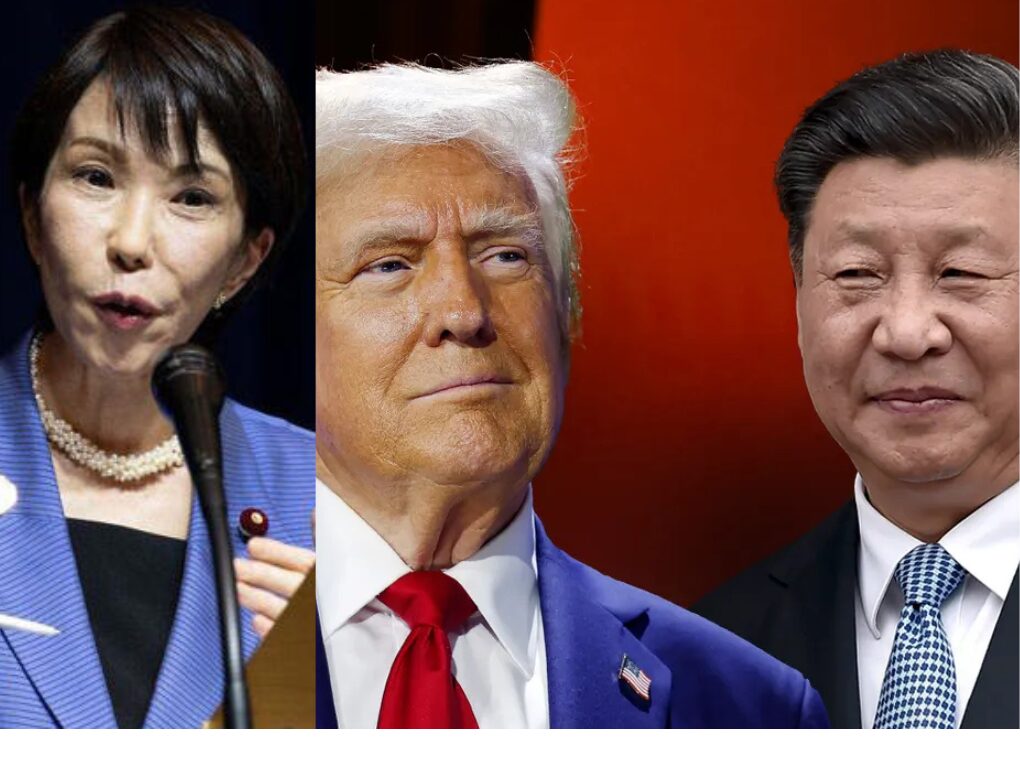
The simulation coincides with a notable diplomatic moment in the region. Japan’s new Prime Minister Sanae Takaichi held a highly publicized call with former U.S. President Donald Trump, reaffirming Tokyo’s commitment to strong U.S.–Japan cooperation in the face of Chinese assertiveness.
Japan’s leadership framed the call as a demonstration of:
Alliance solidarity amid Chinese pressure,
Support for stability in the Taiwan Strait, and
A clear warning that neither Tokyo nor Washington will “kneel down” before Beijing’s aggression.
This comes after months of friction between Japan and China over Taiwan, the Senkaku Islands, and technology export controls. Takaichi’s assertive stance—unusually blunt for Japanese diplomacy—signals a shift toward harder balancing against China.
A Three-Way Power Contest Intensifies
The intersection of China’s technological war-gaming, Japan’s political signaling, and U.S. Indo-Pacific commitments points to a rapidly polarizing environment.
For China
Beijing aims to deter Taiwan from making moves toward greater political autonomy while preventing U.S.-Japan support from strengthening Taipei’s resolve.
For Japan
China’s military expansion and pressure campaigns around Taiwan are viewed as immediate threats. Japan’s southwestern islands are only 100 km from Taiwan, making any conflict directly existential.
For the U.S.
Starlink and similar technologies provide Washington strategic depth. Protecting them—and ensuring allies have access—is becoming essential to U.S. deterrence strategy.
What This Means for Taiwan?
Taiwan has already integrated satellite-based resilient communication systems into its defense planning. The PLA’s focus on Starlink confirms that Taipei’s digital infrastructure is viewed as a major obstacle to China’s desired “quick victory” scenario.
If China cannot guarantee communication dominance, any military action risks becoming prolonged, unpredictable, and globally escalatory.
The Geopolitical Signal
China’s blackout simulations are not just technical exercises—they are political messages. The combination of:
PLA cyber-space drills,
Chinese rhetoric toward Taiwan,
U.S.-Japan strategic coordination, and
Tokyo’s stronger, Trump-aligned posturing
suggests the Indo-Pacific is entering a new phase of competition where satellite warfare, cybersecurity, and communication resilience are as important as tanks and missiles.
China’s simulated Starlink blackout represents a new frontier in cross-strait tensions. It underscores Beijing’s determination to shape the technological landscape of any future conflict, while Japan and the U.S. signal their readiness to counter such ambitions. As Starlink becomes a symbol of Western strategic capability, the struggle for control of information dominance may become one of the defining features of the region’s security landscape.