Washington is buzzing with one of the most audacious ideas yet to emerge from Donald Trump’s second term: a proposed “Core 5” (C5) great-power concert consisting of the United States, China, Russia, India, and Japan — deliberately sidelining traditional European allies and the entire architecture of the post-World War II G7.
The concept first surfaced in reports by Defense One and Politico, which cited sources claiming that an unpublished, longer draft of the Trump administration’s new National Security Strategy (NSS), released last week in a 33-page public version, contained detailed references to establishing the C5 as the primary forum for managing global affairs. The White House has categorically denied that any alternate or classified version exists, with spokesperson Anna Kelly stating, “No alternative, private, or classified version exists.”
Despite the denial, the idea has rapidly gained traction in national-security circles because it fits squarely with President Trump’s longstanding worldview: a preference for direct deal-making with strongman leaders, a belief that legacy multilateral bodies such as the G7 and even the UN Security Council are obsolete, and a willingness to break decades of ideological framing in favor of raw power politics.
What Would the Core 5 Look Like?
According to sources familiar with the reported draft, the C5 would:
Hold regular leader-level summits built around thematic issues rather than fixed agendas.
Serve as the primary mechanism for managing great-power competition and cooperation.
Focus initially on areas of mutual interest such as West Asian diplomacy (particularly an Israeli-Saudi normalization deal), AI governance, critical minerals supply chains, and space.
Effectively replace or marginalize the G7, which Trump has repeatedly criticized as “weak” and unrepresentative of today’s power realities.
The five nations — U.S., China, Russia, India, Japan — together represent roughly 3.5 billion people, the world’s three largest nuclear arsenals, four of the five permanent UN Security Council members (with Japan as the outlier), and the majority of global GDP when measured at purchasing-power parity.
Notably absent: every European state, Canada, and South Korea.
Why It Feels Trumpian?
Multiple former officials and analysts told reporters that the concept, while shocking to traditionalists, aligns closely with Trump’s instincts.
“This aligns with how we know President Trump to view the world — non-ideologically, through an affinity for strongmen, and through a propensity for working with other great powers that maintain spheres of influence in their region,” said Torrey Taussig, former director for European affairs on Joe Biden’s National Security Council.
A former Trump White House official, speaking on condition of anonymity, confirmed that while no formal “C5” label was used in the first term, there were repeated internal discussions that existing institutions were “not fit for purpose given today’s new players.”
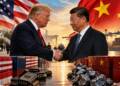
Recent administration actions appear to lend credence to the reports. Defense Secretary Pete Hegseth recently referred to a “historic G2 meeting” between Trump and Chinese President Xi Jinping, prompting alarm on Capitol Hill. Meanwhile, Trump has dispatched personal envoys Steve Witkoff and Jared Kushner to Moscow for direct talks with Vladimir Putin and approved the sale of advanced Nvidia H200 AI chips to China — moves that directly contradict the “great-power competition” framework that dominated his first term.
Europe Left Out in the Cold
The deliberate exclusion of Europe has sparked the sharpest backlash. EU Defense Commissioner Andrius Kubilius accused the Trump NSS of actively seeking to undermine European unity, arguing that references to the continent facing “civilizational erasure” are less about genuine concern for democracy than a strategic desire to prevent any rival power center from emerging.
German, French, and British officials have privately expressed fury at the prospect of being frozen out of the top table. One senior European diplomat told Politico on background: “If the United States wants to manage the world with Beijing and Moscow while treating Europe as Russia’s sphere of influence, they should say it openly.”
India and Japan: The Awkward Guests
India’s inclusion has raised particular eyebrows, given New Delhi’s deepening security partnerships with the United States through the Quad and its historically close ties with Moscow, alongside a tense border standoff with China. Japanese officials, while longtime U.S. allies, are wary of any framework that appears to legitimize Chinese and Russian influence on equal footing.
Congressional and Expert Alarm
On Capitol Hill, Rep. Raja Krishnamoorthi (D-Ill.), ranking member of the House Select Committee on China, wrote to Secretary Hegseth expressing “profound concern” over the “G2” language and warning that embracing Beijing as a co-equal partner “risks dangerously undermining the Pentagon’s preparations for deterring conflict in the Indo-Pacific.”
Michael Sobolik, a former aide to Sen. Ted Cruz during Trump’s first term, called the reported shift “a huge departure” from the previous administration’s competitive stance toward China.
A New Concert of Powers or a Dangerous Fantasy?
Proponents of the idea — few of whom will speak on the record — argue that the 21st century demands a forum that reflects actual power distribution rather than 1945 or 1991 arrangements. Critics counter that legitimizing Russia’s invasion of Ukraine and China’s South China Sea claims in exchange for a seat at an exclusive table would shatter the rules-based order Washington spent decades building.
For now, the Core 5 remains a reported concept, not policy. Yet in an administration that prides itself on disruption, the very fact that the idea is being seriously discussed — and that the White House felt compelled to deny a document’s existence — suggests that the post-war liberal international order is facing its most direct challenge in decades.
Whether the C5 ever holds its first summit or dies quietly in internal memos, one thing is clear: Donald Trump’s second term is determined to rewrite the global operating system — and Europe, for the first time since 1945, may not be invited to help write the code.