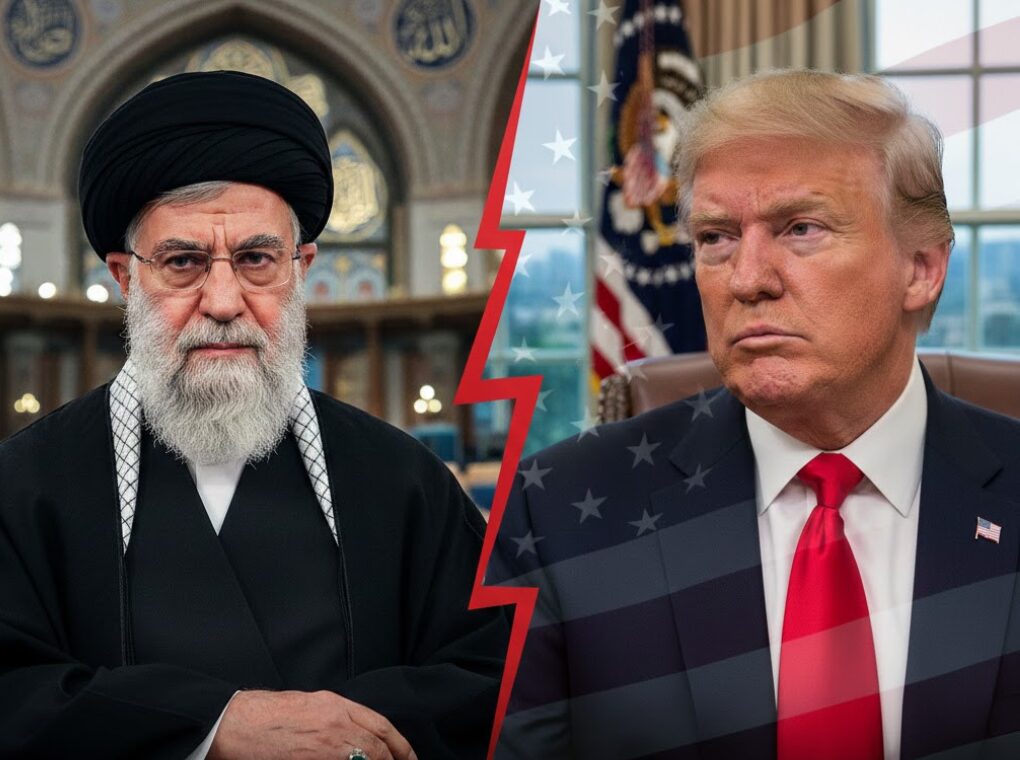
Temperatures in West Asia are rising sharply as the United States expands its military presence near Iran, triggering speculation that Washington may be preparing contingency plans for potential strikes. Although American officials publicly maintain that no final decision on military action has been made, the scale and speed of recent deployments have drawn global attention and fueled concerns about a new flashpoint in an already volatile region.
A Visible Show of Force
At the center of the buildup is a powerful U.S. naval presence led by a carrier strike group operating in waters near the Persian Gulf. Aircraft carriers serve as floating airbases, capable of launching sustained air operations without relying on regional airfields. Accompanying warships provide missile defense, intelligence support, and strike capabilities, forming a mobile force designed for both deterrence and rapid response.
Alongside naval assets, the U.S. Air Force has reinforced its footprint at key bases across the region. Advanced fighter aircraft capable of precision strikes have been repositioned closer to Iran, supported by aerial refueling tankers that extend their operational range. The movement of missile defense systems has also been observed, suggesting preparations not only for offensive options but also for protecting U.S. personnel and allied infrastructure from potential retaliation.
Military analysts note that such combined deployments — air power, naval forces, and missile defense — typically indicate readiness for multiple scenarios, ranging from deterrence signaling to limited strikes or defensive operations.
Why Now?
The timing of the military buildup appears closely linked to escalating disputes between Washington and Tehran over Iran’s nuclear program, missile development, and regional influence. U.S. leadership has renewed pressure on Iran to curb uranium enrichment and reduce support for allied armed groups in the Middle East. Tehran, however, insists its nuclear activities are sovereign rights and has rejected expanding negotiations beyond nuclear issues.
Diplomatic contacts have reportedly taken place in parallel with the military movements, reflecting a familiar pattern in U.S.–Iran relations where talks and tensions unfold simultaneously. Still, history shows that military pressure can complicate diplomacy by deepening mistrust on both sides.
The buildup may also be intended as a deterrent message — not only to Iran but to regional actors. By demonstrating overwhelming military readiness, Washington signals that attacks on U.S. forces or allies would carry severe consequences.
Iran’s Defiant Response
Iranian officials have responded with strong rhetoric, stating that foreign military deployments near their borders will not influence national policy. Leaders in Tehran have emphasized that their missile capabilities and regional partnerships are defensive in nature, while warning that any attack on Iranian territory would prompt retaliation against U.S. bases and interests in the region.
This exchange of warnings has heightened fears of miscalculation. Even a limited incident — such as a drone confrontation, naval encounter, or militia strike — could spiral into a broader conflict if either side interprets it as deliberate escalation.
Regional Stakes Are High
The Middle East sits at the heart of global energy supply routes, and any conflict involving Iran could have far-reaching economic consequences. The Strait of Hormuz, a narrow waterway through which a significant portion of the world’s oil passes, would be particularly vulnerable in the event of hostilities. Disruptions there could drive energy prices sharply higher and unsettle international markets.
Regional governments are watching closely. Many Gulf states host U.S. military facilities but also seek to avoid becoming battlegrounds in a U.S.–Iran confrontation. Behind the scenes, quiet diplomacy is reportedly aimed at preventing escalation and keeping communication channels open.
Israel’s security concerns also factor into the equation. Israeli leaders have long warned about Iran’s nuclear and missile programs, and close coordination between Washington and Tel Aviv adds another layer of strategic calculation.
Is a Strike Imminent?
Despite the heightened military posture, a U.S. attack on Iran is not considered inevitable. Military deployments can serve as leverage in negotiations or as insurance against worst-case scenarios rather than signals of immediate action. However, the risk environment is undeniably elevated.
Large force concentrations increase the chance of unintended clashes, especially in crowded airspace and contested waterways. In such tense conditions, even routine military maneuvers can be misinterpreted.
A Critical Moment Ahead
The coming weeks will likely prove decisive. If diplomatic channels gain momentum, the military presence may gradually shift back toward a deterrence role. If talks stall and rhetoric hardens, pressure could mount for more assertive measures.
For now, the U.S. buildup near Iran stands as one of the most significant military movements in the region in recent years — a reminder that the balance between deterrence and escalation in West Asia remains dangerously delicate.