Tensions in the Persian Gulf have intensified dramatically as Iran continues launching missile and drone attacks against the United Arab Emirates. Over the past few days, multiple strikes have targeted critical infrastructure, including the Fujairah Port and areas near Dubai International Airport, raising fears of a broader regional conflict.
The attacks came shortly after the United States carried out military strikes on Kharg Island, Iran’s most important crude oil export hub located roughly 25 kilometers off its southern coast. The escalating cycle of retaliation has placed the UAE—one of the Gulf’s most important economic and logistics hubs—directly in the crosshairs of Tehran’s military strategy.
US Strikes on Kharg Island Spark Retaliation
The latest escalation began when US forces launched strikes on Kharg Island, a strategic energy facility responsible for exporting a large portion of Iran’s crude oil. According to US officials, the operation targeted military infrastructure such as missile storage bunkers, naval mine depots, and air defence systems located on the island.
Following the strikes, Iran’s military command warned that it would retaliate against any country supporting attacks on its oil and military infrastructure. Within hours, Iranian drones and missiles reportedly targeted Fujairah Port in the UAE, a vital oil export terminal located on the Gulf of Oman just outside the Strait of Hormuz.
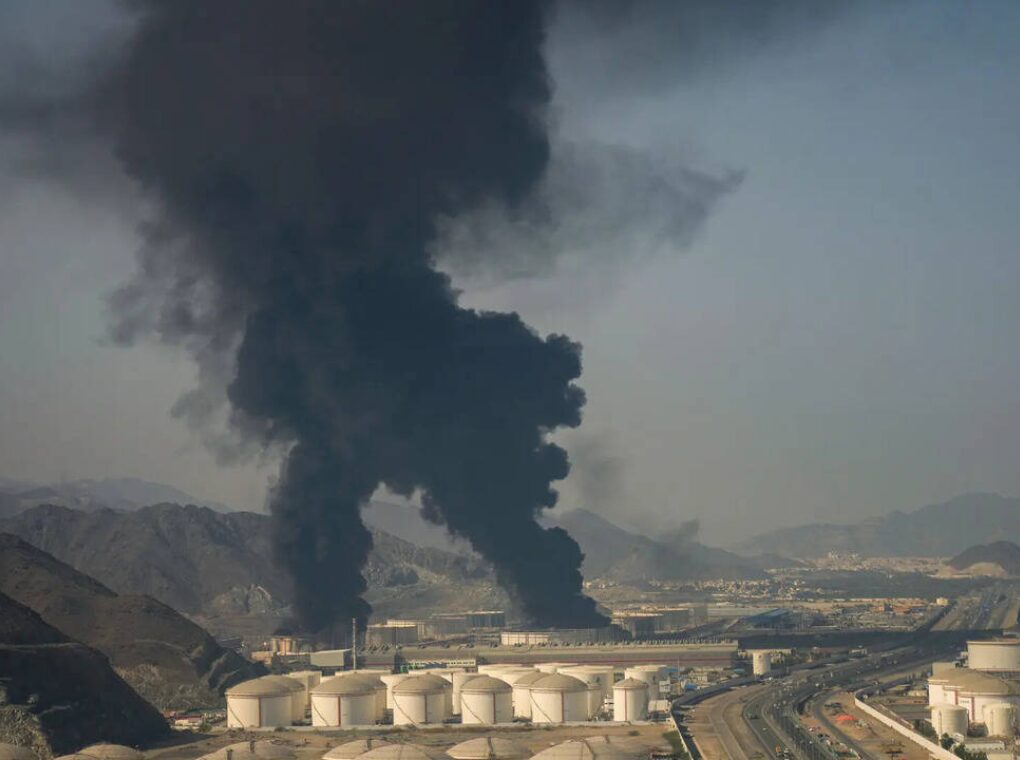
Fujairah handles roughly one million barrels of oil exports per day, making it a crucial node in global energy supply chains. Videos circulating online showed thick black smoke rising from parts of the port area after drone debris reportedly triggered fires. Emirati authorities confirmed that air defence systems intercepted several incoming projectiles, though fragments caused localized damage.
Drone Incident Disrupts Dubai Airport Operations
The conflict also briefly disrupted aviation operations in Dubai. A drone-related incident near Dubai International Airport caused a fire, forcing authorities to temporarily suspend flights as a precaution.
Residents in several districts of Dubai reported hearing loud explosions during the night. The UAE Ministry of Defence later stated that its air defence systems had intercepted multiple incoming threats, including ballistic missiles and drones launched from Iran.
Officials claimed that more than 40 aerial threats were intercepted in a single day, highlighting the scale of the attacks. The UAE has said that since the conflict began, it has faced more than 1,800 missile and drone launches from Iran, with interception rates reportedly exceeding 90 percent.
Iran Accuses UAE of Hosting US Military Launch Sites
One of the key reasons behind Iran’s continued attacks lies in Tehran’s accusation that the UAE allowed its territory to be used for US military operations against Iranian targets.
Iranian Foreign Minister Abbas Araghchi claimed that US HIMARS rocket systems positioned near Dubai and Ras Al Khaimah were used to launch strikes on Kharg Island and other Iranian locations.
According to Araghchi, the attacks originated from locations “very close to Dubai,” a claim that the UAE has strongly denied.
Senior Emirati official Anwar Gargash, adviser to the UAE president, dismissed the accusations and insisted that the country has not allowed its territory to be used for attacks against Iran. He said the UAE remains committed to diplomacy while retaining the right to defend itself against aggression.
Strategic Pressure on US Allies
Analysts believe Iran’s strikes are part of a broader strategy aimed at raising the cost of the war for Washington and its regional allies. The UAE hosts key US military facilities and is considered one of Washington’s closest security partners in the Gulf.
By targeting ports, airports, and oil infrastructure in the UAE, Tehran can send a clear message that countries supporting the United States could face serious economic and security consequences.
Strategic sites such as Fujairah Port and Dubai’s aviation infrastructure are particularly attractive targets because of their importance to global trade and energy markets. Even limited attacks—especially those that are intercepted—can still disrupt operations and shake investor confidence.
Economic and Symbolic Targets
Another major factor is the UAE’s global reputation as a safe business and tourism hub. Cities like Dubai and Abu Dhabi depend heavily on their image as stable financial centers connecting Asia, Europe, and the Middle East.
By striking high-profile locations, Iran may be attempting to undermine that perception and demonstrate that even the Gulf’s most secure commercial hubs are vulnerable during wartime.
Energy analysts also warn that attacks near the Strait of Hormuz could threaten one of the world’s most important maritime chokepoints. Nearly a fifth of global oil shipments pass through the narrow waterway each day.
Regional Tensions Continue to Rise
With missile attacks continuing and oil infrastructure increasingly at risk, Gulf nations are becoming more alarmed. The Gulf Cooperation Council, which includes Saudi Arabia, the UAE, Qatar, Bahrain, Kuwait, and Oman, recently held an emergency meeting to coordinate regional defence measures.
The group invoked Article 51 of the UN Charter, signaling readiness for collective self-defence if attacks continue.
For now, the conflict shows no signs of easing. As long as Iran believes Gulf states are enabling US military operations, analysts warn that the UAE and other regional partners could remain prime targets in the expanding war across the Persian Gulf.