Türkiye and Saudi Arabia have signed two landmark memorandums of understanding that could reshape the geopolitical and economic map of the Middle East — launching a sweeping railway and logistics corridor linking the Gulf to Europe via Syria and Jordan, a route that conspicuously bypasses Israel and directly challenges the America-backed India-Middle East-Europe Economic Corridor, known as IMEC.
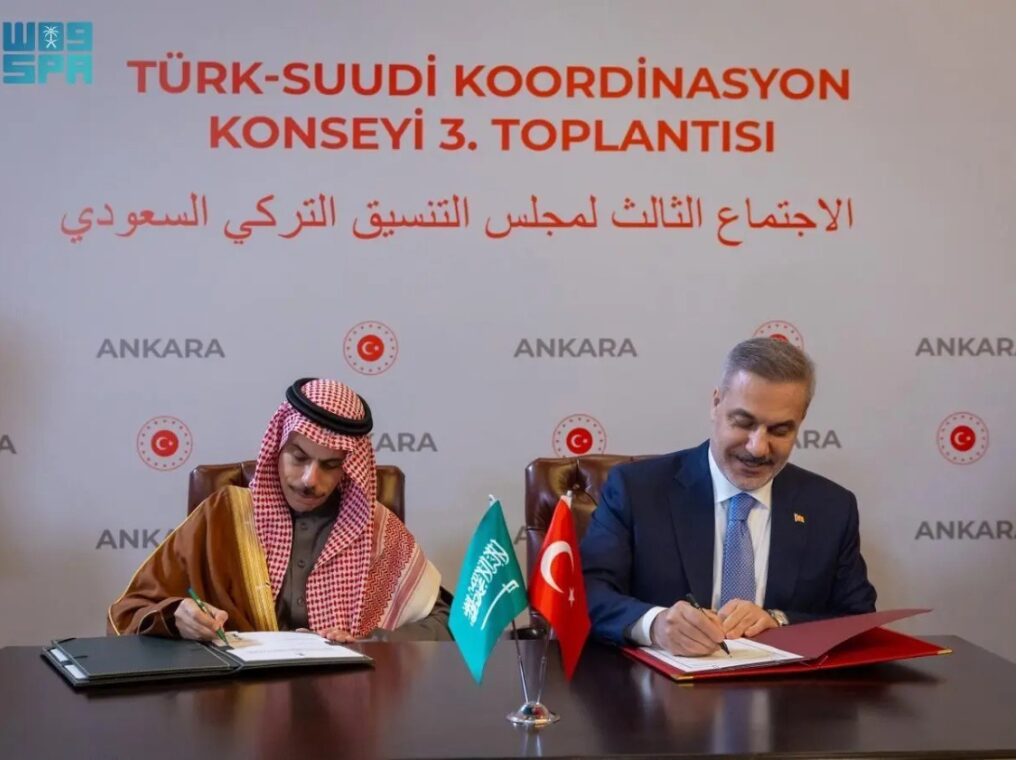
The agreements were signed in Riyadh on Tuesday 9 June 20206 by Saudi Minister of Transport and Logistic Services Saleh Al-Jasser and Turkish Minister of Transport and Infrastructure Abdulkadir Uraloglu, following high-level talks between the two governments. The first memorandum covers cooperation in logistics services, including the construction and joint operation of logistics centres, while the second focuses on railway technology, infrastructure, and knowledge sharing.
A Corridor Reborn from History
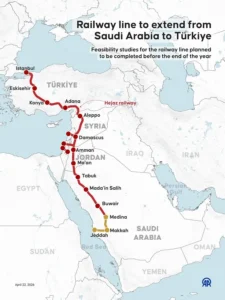
The vision behind the new corridor is not simply a matter of modern infrastructure planning — it is a deliberate act of historical retrieval. The proposed route runs along the ghost of the Hejaz Railway, originally built by the Ottoman Empire in the early twentieth century to connect Istanbul to the holy cities of Makkah and Madinah. That railway fell largely into disuse after World War I, its iron tracks buried under decades of conflict, shifting borders, and geopolitical fracture.
Now, a century later, its route is being reclaimed. The planned corridor would connect Türkiye existing rail network southward through Syria via Aleppo and Damascus, continue through Jordan down to the Red Sea port of Aqaba, and then enter Saudi Arabia — with Makkah, Madinah, and the futuristic megacity NEOM among the key stations envisioned. In the longer term, Turkish officials have stated an ambition to extend the line all the way to Oman, creating an overland route that bypasses the Strait of Hormuz entirely.
Months in the Making
Tuesday’s bilateral agreements are the culmination of months of diplomatic groundwork. In April 2026, Turkey, Syria, and Jordan signed a trilateral transport memorandum in Amman, agreeing on a plan to rehabilitate cross-border transport infrastructure over the next four to five years. That agreement established the first formal framework for restoring rail and road links badly damaged — or outright destroyed — during more than a decade of conflict in Syria.
Türkiye has already begun translating that agreement into physical action. Turkish authorities have started restoring railway lines near the Syrian border that had been dormant for around fifteen years. Separately, Turkish Transport Minister Uraloglu confirmed that two test freight journeys from Turkey through Iraq to Saudi Arabia had demonstrated that an overland road route was also viable, providing momentum ahead of the Riyadh signing.
With Saudi Arabia now officially on board, what began as a trilateral regional framework has grown into a project with intercontinental ambitions — a logistics corridor spanning from southern Europe to the Arabian Peninsula.
Challenging the Chokepoints
The project carries urgent strategic logic beyond its historical symbolism. The Strait of Hormuz — through which a fifth of the world’s oil supply flows — has been blockaded as part of the ongoing US-Iran war, triggering severe disruptions to global shipping. The Red Sea, already battered by Houthi attacks in previous years, remains a volatile transit corridor. In this environment, an overland route that bypasses both chokepoints has moved from an ambitious idea to a pressing strategic need.
Turkish Transport Minister Uraloglu struck an explicitly urgent tone at the signing. “At this sensitive time our region is going through,” he said, “the uninterrupted functioning of trade and the logistics chain has become more critical than ever.” Ankara has not been shy about its broader goal: Turkey aims to position itself as the central transit hub connecting Gulf energy and trade to European markets, a junction where multiple corridors converge.
The Geopolitical Subtext: Bypassing Israel/IMEC
The corridor’s political implications are at least as significant as its infrastructure ambitions. Ankara made no effort to conceal the competitive edge of the project. Turkish officials openly stated that the railway would reduce Israel’s regional influence, and regional commentary has been swift to agree.
supporters described the signing as a “fatal blow to one of Israel’s most strategically significant economic projects” — a reference to IMEC, the corridor announced at the G20 in New Delhi in 2023, which was designed to connect India to Europe via the UAE, Saudi Arabia, Jordan, and Israel’s Haifa port.
IMEC has faced compounding difficulties since its launch. The October 7, 2023 Hamas attacks and Israel’s subsequent military campaign in Gaza effectively froze momentum on the project, which had required Saudi-Israeli normalization as a foundational precondition. A 2026 Washington Institute survey found that 99% of Saudi respondents opposed normalization with Israel, a figure that has made any political progress on IMEC essentially unworkable in the current climate.
The Atlantic Council has assessed IMEC’s financing gap at approximately $5 billion just to become minimally operational, with most of the unmet costs concentrated in Jordan, Israel, and proposed logistics hubs.
Meanwhile, analysts at the Foundation for Defense of Democracies have noted a structural advantage in Turkey’s model: “Unlike IMEC, which depends on Israel as a major transit point, Turkey’s routes avoid one of the most politically volatile chokepoints in the region.”
Syria’s Quiet Return to the Map
One of the most consequential — and underreported — dimensions of the new corridor is what it signals for Syria. For years a pariah state under international sanctions, Syria under its post-Assad government has been the subject of cautious but accelerating regional engagement. Saudi Arabia has reportedly expressed willingness to invest billions in reconstructing war-damaged Syrian infrastructure, partly on the condition that Syria serves as a key node in the emerging trade network — one that routes goods to the Mediterranean while avoiding Israeli territory. Syria’s prospective inclusion in a major international transport corridor would mark its most significant reintegration into the regional economic order since the outbreak of its civil war.
A New Map of Influence
The railway pact is ultimately a declaration about where the region’s centre of gravity is moving. Turkey, excluded from IMEC, has spent the past two years methodically constructing an alternative — not merely a competing trade route, but a competing vision of regional architecture, one centred on Ankara rather than Tel Aviv or Washington.
Saudi Arabia’s willingness to formally endorse that vision, even at the level of memorandums of understanding, is a meaningful signal. Riyadh has long sought to diversify its strategic partnerships and reduce dependencies that leave it exposed — whether to volatile chokepoints, to conditions imposed by Washington, or to the political liabilities that come with Israeli transit. The new corridor offers all three kinds of relief simultaneously.
Whether the project can overcome the formidable obstacles ahead — damaged infrastructure, complex diplomacy, and the perennial gap between memorandums and construction — remains to be seen. But as a statement of intent, Turkey and Saudi Arabia have drawn a new line on the map. And it does not pass through Israel.