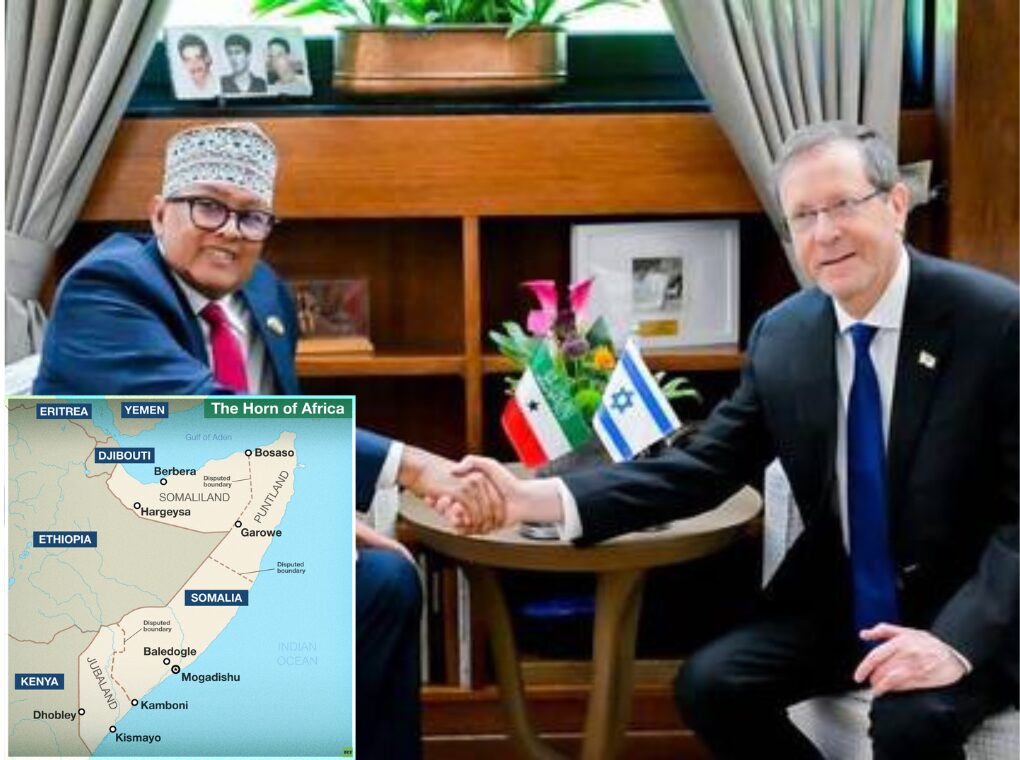
Somaliland President Abdirahman Mohamed Abdullahi has made his first official visit to Israel, marking a historic diplomatic moment months after Israel controversially recognized Somaliland as an independent state.
Abdullahi was welcomed with full state honors by Israeli President Isaac Herzog at the Presidential Residence in Jerusalem on Sunday in what officials described as the first-ever state visit by a Somaliland leader to Israel.
The visit comes amid growing geopolitical tensions in the Horn of Africa and increasing international scrutiny over Israel’s decision to formally recognize Somaliland, a breakaway region that Somalia still considers part of its sovereign territory.
Israel-Somaliland Relations Move “From Declarations to Action”
During the meeting, President Herzog called the visit a symbol of a growing partnership between the two sides and stressed the importance of transforming diplomatic recognition into concrete cooperation.
“It is a great honor to receive President Abdullahi,” Herzog said, describing the trip as evidence of the “great potential of the new partnership” between Israel and Somaliland. He added that both sides must now move “from declarations to action.”
According to Somaliland’s presidency, discussions focused on expanding cooperation in **investment, technology, agriculture, innovation, economic partnerships, and regional security**.
Abdullahi also visited major symbolic sites in Jerusalem, including the **World Holocaust Remembrance Center (Yad Vashem), Mount Herzl, and the Grove of Nations, where he planted a commemorative tree.
Somaliland Leader Thanks Israel for Recognition
Speaking at a joint press conference, Abdullahi thanked Israel for recognizing Somaliland’s decades-long quest for international legitimacy.
“The people of Somaliland spent decades asking only one thing — to be seen,” Abdullahi said. “Only one country decided to see us,” he added, referring to Israel.
Israel officially recognized Somaliland as a sovereign state in December 2025, becoming the first and only country to do so. Israeli Prime Minister Benjamin Netanyahu’s government described the move as being aligned with the spirit of the Abraham Accords, aimed at reshaping diplomatic ties across strategic regions.
The recognition was accompanied by a joint declaration between the two governments, signaling deeper political and economic engagement.
Somalia Condemns Israel’s Recognition of Somaliland
The move has triggered sharp criticism from Somalia, which maintains that Somaliland remains part of its internationally recognized territory.
The Somali government in Mogadishu condemned Israel’s recognition as a violation of Somalia’s sovereignty and territorial integrity, rejecting Somaliland’s plans to establish an embassy in Jerusalem.
Somalia has repeatedly argued that any unilateral diplomatic actions taken by Somaliland carry no legal standing under international law.
The African Union (AU) has also expressed concern, warning that recognizing Somaliland could create a “dangerous precedent” that may destabilize the continent and encourage separatist movements elsewhere in Africa.
Somaliland’s Long Push for International Recognition
Somaliland declared independence in 1991 following the collapse of Somalia’s central government and years of civil war. The territory had briefly existed as an independent state after gaining independence from Britain in 1960, before voluntarily uniting with Italian Somaliland to form the Somali Republic.
Despite operating with its own government, military, currency, and democratic institutions for decades, Somaliland has struggled to secure broad international recognition.
President Abdullahi, who took office in December 2024, has made diplomatic recognition a cornerstone of his foreign policy agenda.
Taiwan Ties Add to Regional Tensions
Abdullahi’s visit to Israel follows Somaliland’s decision to strengthen relations with Taiwan. Last week, Somaliland inaugurated a new representative office in Taipei despite objections from both Somalia and China.
Somaliland officials defended the move, insisting that Hargeisa has the sovereign right to choose its international partnerships.
“We have the right to choose who we have relationships with. It’s our prerogative,” Somaliland representative Mahmoud Adam Jama Galaal said, according to Reuters.
The simultaneous deepening of ties with Israel and Taiwan is expected to intensify diplomatic pressure from Somalia, China, and other regional stakeholders.
Why Somaliland’s Israel Visit Matters
The visit is widely seen as a major geopolitical development in the Horn of Africa, signaling Somaliland’s growing push for international legitimacy while positioning Israel in a strategically important region near the Red Sea and Gulf of Aden.
For Somaliland, Israel’s recognition offers diplomatic momentum after decades of isolation. For Israel, closer ties may provide new economic and security partnerships in one of Africa’s most strategically sensitive regions.
However, the move also risks escalating diplomatic tensions with Somalia and triggering broader debates over sovereignty, recognition, and regional stability in Africa.