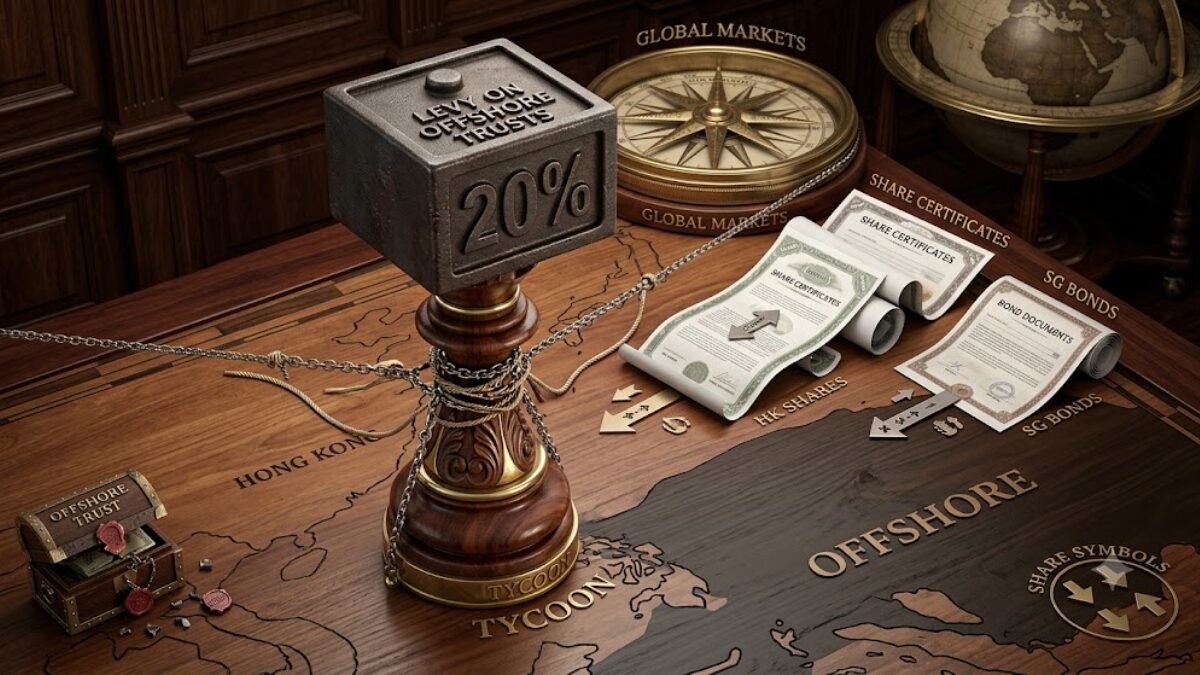
A 20 per cent levy on offshore trusts has tycoons hunting for cash from Hong Kong to Singapore, and some are selling shares to find it.
Wealthy Chinese families have until October 22 to declare and pay tax on assets moved into offshore trusts since the start of 2023, after Beijing imposed a 20 per cent levy on structures that sat in a tax grey zone for decades. CNBC reported on August 5 that the countdown has set off a rush to lawyers, private bankers and trustees across the two cities, with some families already picking which holdings to sell.
Clifford Ng, a Hong Kong-based partner at Zhong Lun, told CNBC that many clients, trustees and advisers were still in shock, and that assembling accurate numbers within 90 days may not be possible at all.
What the rules actually do
The Ministry of Finance and the State Taxation Administration published the framework on July 24 as Announcement No. 21 of 2026, with a procedural companion, Announcement No. 15.
According to law firm Morgan Lewis, the rules treat a resident’s transfer of property into an offshore trust as a deemed disposal and tax the resulting gain at 20 per cent. Trust income is then taxed annually, and taxed again on distribution and termination. Caixin reported the levy applies at the establishment, operating and liquidation stages — in practice, almost every point in a trust’s life.
Article 17 opens a 90-day window for historical liabilities: unpaid tax on property contributed by residents between January 1, 2023, and December 31, 2025, plus pre-2026 trust income, reported as interest, dividend and bonus income. Morgan Lewis stressed the provision is “not framed as a general amnesty or blanket waiver” — paying on time avoids late-payment surcharges, and no more. Taxpayers can in some cases apply to spread the bill over five years.
Why Beijing moved now
Money is the short answer. Revenue from land sales, long the mainstay of local government finance, fell 31.5 per cent to 977.8 billion yuan in the first half of 2026. Personal income tax went the other way, rising 13.1 per cent to 898.2 billion yuan, outpacing income growth by nearly eight percentage points.
The trigger was also very public. The fight over the estate of Zong Qinghou, the Wahaha founder who died in February 2024, exposed a US$2.1 billion offshore portfolio after three children born outside his marriage sued his daughter Kelly Zong in Hong Kong and Hangzhou. A Hong Kong court froze a US$1.8 billion HSBC account held through a British Virgin Islands company. The South China Morning Post said the case laid bare a little-known grey area, and that the July statement marked the shift to enforcement. Tax bureaus in Shanghai, Shenzhen and Jiangsu had already been inspecting trusts and applying 20 per cent levies in selected cases.
How the money gets found
Richard Grasby, a partner at Appleby in Hong Kong, told CNBC that declared figures will have to match data foreign governments already send Beijing under the Common Reporting Standard, which China joined in 2018. He also warned that dipping into the trust to pay the bill can itself trigger further tax.
A foreign passport offers little cover: individuals can still be treated as Chinese tax residents if their primary economic interests remain in China. “A second passport is not a tax plan,” said Kia Meng Loh, senior partner and chief operating officer at Dentons Rodyk in Singapore.
What it means for markets
Loh said clients are weighing distributions, asset sales, financing and instalments. Ryan Lin, a director at Singapore’s Bayfront Law, told CNBC most of his clients intend to liquidate part of their portfolios, with Hong Kong-listed and A-share holdings likely to bear the brunt as the most liquid assets.
Citigroup economist Xiangrong Yu said the retrospective window could force pre-emptive stake reductions. Others are calmer. Edith Qian of CGS International noted most large red-chip names listed well before the 2023 look-back began, while Dominic Chiu of Eurasia Group expects episodic selling rather than a sustained rout.
Assets under trust in Hong Kong reached HK$5.2 trillion (US$667 billion) in 2023, with 55 per cent of underlying investments in the mainland and Hong Kong, according to KPMG and the Hong Kong Trustees’ Association. Hong Kong overtook Switzerland in 2025 as the world’s largest cross-border wealth centre, with US$2.9 trillion booked, Boston Consulting Group found.
Still unsettled
STEP noted that residents receiving distributions from non-resident-funded trusts must also file within 90 days, but no look-back start date is specified. Valuing pre-IPO stakes, operating companies and property is a second problem; old banking records may simply be gone.
Michael Olesnicky, senior consultant at Baker McKenzie, told CNBC that trusts still serve asset protection and succession planning — they no longer work as tax planning. There’s no stampede to unwind them yet, partly because collapsing a trust crystallises the very bill families are trying to manage.