
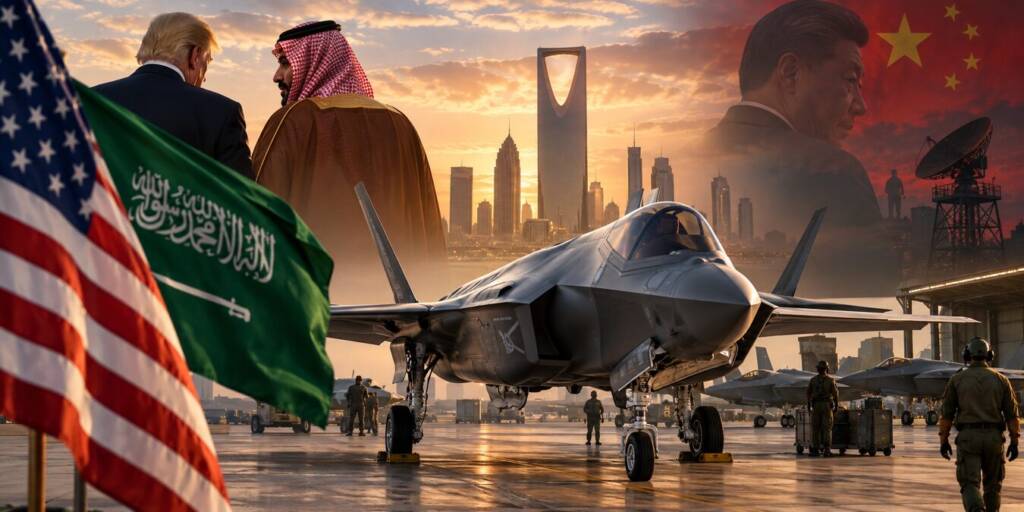
President Donald Trump’s administration on Thursday cleared the sale of 48 F-35 stealth fighters to Saudi Arabia. The State Department put the deal’s value at an estimated $24.3bn and notified Congress.
A day earlier, the US intelligence community warned that China could steal F-35 secrets. The approval also lands as Saudi Arabia fights intensifying battles with Yemen’s Houthi rebels. The F-35 is America’s most advanced fighter, and only Israel flies it in the region.
What Washington says about the F-35 Exoprt
The notice also lists 49 Pratt & Whitney engines, spare parts, training and logistics support. The department said the sale would strengthen a major non-NATO ally and help Riyadh deter threats.
The administration said the jets would “not alter the military balance in the region.” Trump first announced the sale in November 2025, before hosting Saudi Crown Prince Mohammed bin Salman.
The China warning
Intelligence analysts fear Beijing could obtain F-35 technology through spying or military ties. A report by the Pentagon’s Defense Intelligence Agency examined Chinese military access to Saudi bases and questioned whether Saudi Arabia could adequately secure sites housing sensitive F-35 systems.
US intelligence officials asked whether Riyadh would strip Huawei and ZTE equipment from F-35-linked networks and bases. China has sold ballistic missiles to Riyadh and helped it build missile production plants.
Representative Raja Krishnamoorthi, a Democrat on the House Intelligence Committee, said the sale should not proceed. He warned it could place “the crown jewels of American military technology” within Beijing’s reach.
Similar worries helped stall Trump’s first-term plan to sell F-35s to the United Arab Emirates.
Why sell despite Riyadh’s China ties?
The answer appears to mix money and strategy. The White House said the package strengthens US arms makers and keeps Saudi Arabia buying American. Riyadh has also pledged to raise its US investments to $1 trillion.
Hudson Institute analyst Can Kasapoglu argued that Saudi ties with China likely pushed Trump to proceed. Riyadh has signalled it will look elsewhere if Washington hesitates, he said. Saying no, he argued, could hand Beijing an opening in a strategically vital Gulf market. The kingdom has held advanced talks on joining Turkey’s Kaan fighter programme.
Why the F-35 deal is controversial
Beyond China, the deal touches two other nerves: Israel’s military edge and the war in Yemen.
US law obliges Washington to keep Israel militarily ahead of its neighbours. Israeli defence officials have warned that Saudi F-35s could erode that edge. US officials have assessed that Saudi jets could carry fewer capabilities than Israel’s, though Trump said last November that the Saudi jets would be “pretty similar.” A formal review of the sale’s impact on Israel’s edge has yet to take place, experts say.
Israel sought to link the sale to Saudi-Israeli diplomatic ties, but Thursday’s notice did not mention that condition.
On Wednesday, the Houthis claimed they shot down a Saudi F-15 over Marib with their own missile. According to reports, fighting on Thursday killed at least five people, including three children.
Is Washington telling Riyadh to fend for itself?
In part, yes, if the Pentagon’s own strategy is any guide. Its 2026 National Defense Strategy wants regional partners to take “primary responsibility” for deterring Iran, pairing that with “critical but more limited” US support.
Washington has declined a direct role in Riyadh’s fight against the Houthis. Saudi forces have struggled against Iranian attacks during the US-Israeli war on Tehran.
According to reports, Riyadh is also running short of missile interceptors. It has asked France, Pakistan, Egypt and Britain for air-defence help. US interceptor stocks have dwindled during the Iran war too, one official said.
Saudi Arabia’s status as a major non-NATO ally brings privileges but no US security guarantee. Last November’s US-Saudi defence pact also secured Saudi funds to offset US costs, the White House said.
Riyadh is hedging too. On 7 August, it signed a mutual defence pact with Pakistan and Turkey in Mecca — though that pact has no joint command or standing forces, and neither Pakistan nor Turkey has agreed to help Saudi Arabia militarily.
Washington is not walking away, though. The message from Riyadh’s benefactor looks clear: carry more of your own defence, but buy American.
What happens next
Congress now has 30 days to review the sale. Lawmakers could vote to block it, but Trump could veto their move; overriding a veto would need two-thirds majorities in both chambers. Final terms, contracts and production could still take years.
Earlier this month, Washington also approved a $5bn sale of over 10,000 bombs to Riyadh. For now, the jets remain on paper, but the politics have already taken flight.