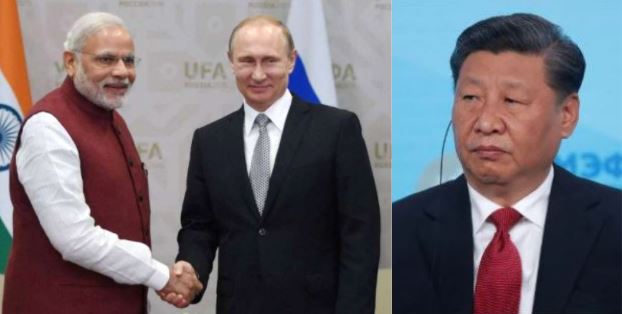
An isolated China is becoming desperate for diplomatic and geopolitical exploits. And now that Joe Biden is about to take charge as the next US President, Beijing wants to latch onto the opportunity. Biden, a Russophobic Democrat, is expected to take a tough stance against Moscow as opposed to the sitting US President Donald Trump. Nevertheless, Indo-US ties are set to keep improving.
So, China wants to use the opportunity and drive a wedge between India and Russia. Any cracks in the time-tested Indo-Russian alliance would be a huge advantage for Beijing. But the Chinese government seems to have misunderstood the India-US-Russia equations here. And therefore, the paper dragon is bound to fail in its devious plans.
Global Times, a Chinese state-owned publication that publicly writes what Chinese policymakers secretly think, has published two ill-conceived stories about the Indo-Russian alliance. One of the two stories titled, “Russia moves East, India West, straining ties”, tries to illustrate the so-called cracks appearing between the ‘Indian elephant’ and the ‘Russian bear’.
Global Times wrote, “Year after year, New Delhi is moving west, building stronger links to the US. If this trend continues into the mid-term future, the two friendly countries (India and Russia) might ultimately find themselves in the opposite geopolitical and economic blocks, and the Eurasian space will split into two pieces.”
The other story titled, “India embraces the US at cost of Russia ties,” tries to illustrate how the ‘Indian elephant’ is spoiling the Indo-Russian relationship. The CCP mouthpiece stated, “Moscow sees that New Delhi has been getting closer to Washington as two formed a quasi defense alliance. This has severely infringed upon the interests of the traditional weapons trade between Russia and India.”
The problem with Global Times here is oversimplification. It has misunderstood both Russia and India. From New Delhi’s perspective, embracing US ties “at cost of Russia ties” simply doesn’t make any sense. Unlike the Chinese Communist Party in Beijing, India isn’t in the habit of abandoning or backstabbing allies or partners in search of better partners.
Over the past one and a half decades, the Indo-US relations have been improving but New Delhi has never left Moscow behind. The same trajectory is bound to continue in the medium and long-term future also.
Now, the Russian perspective is even more difficult for China to understand. Global Times is actually thinking of Russia as a North Korea or a Pakistan. But Russia would never abandon India and join a geopolitical/economic bloc led by China against the US.
Firstly, Russian and Chinese interests often militate against each other. And secondly, Putin’s Russia is not the one to play second fiddle to China. Yet, Beijing keeps thinking of China in the narrow binary of geopolitical blocs.
Also, Joe Biden may think of Russia as a foe. India itself may become a foe’s friend from the Kremlin’s perspective. But in diplomacy, a foe’s friend isn’t essentially a foe, especially when the principal foe is someone as powerful as the United States of America.
If Joe Biden actually harks Washington back to the era of mindless antagonism towards Moscow, then Putin would be even more inclined to deepen Indo-Russian ties. While clubbing itself with China can bring more American sanctions for Russia, the Indo-Russian alliance will help Putin stave off at least some of the American pressure directed at the Kremlin.
China is probably misguided by Russia’s seemingly cold remarks about India’s Indo-Pacific relations with the Western world and the Quad. However, what Beijing doesn’t realise is that Moscow has never criticised India and the Putin administration’s insecurities remain directed at the West.
Nonetheless, China’s desperation is understandable. While India has many allies such as Japan, Taiwan, South Korea, Australia, the US and Vietnam, China is still struggling to seal a formal partnership with Russia. Therefore, it is trying to cause a division in the Indo-Russian alliance but Beijing is bound to fail spectacularly in its nefarious designs.