
In the modern era of global military competition, strength is no longer measured by parade-ground spectacles or export figures alone — it’s tested in real conflict. And when it comes to actual battlefield performance, China’s military power continues to fall short of expectations, especially when compared to the United States, its Western allies, and increasingly, India.
Despite its status as the world’s second-largest military spender and its aggressive push into global arms markets, China has yet to prove that its systems can match the reliability, effectiveness, and interoperability that define Western military capabilities. From Africa to South Asia, the track record of Chinese-made weapons shows a pattern of underperformance and technical failure, raising fundamental questions about Beijing’s claim to superpower status.
The Pakistan Lesson: Buying Cheap, Paying Dear
Recent clashes between India and Pakistan brought these shortcomings into sharp focus. In response to India’s Operation Sindoor — a series of precision airstrikes on terror camps in Pakistan and Pakistan-occupied Kashmir — Pakistan retaliated using Chinese-supplied J-17 fighter jets, PL-15 missiles, and drones. The results were underwhelming.
India’s advanced air defence systems, combining indigenous innovations Akash and Russian-made S400, intercepted all threats with ease. The HQ-9 air defence system, China’s flagship export modeled after Russia’s S-300, failed to shield Pakistani military assets. Likewise, Chinese drones and missiles were either neutralized mid-air or rendered ineffective by Indian electronic warfare capabilities.
This confrontation served as a live-fire test of China’s exports — and they failed.
Reverse-Engineering ≠ Innovation
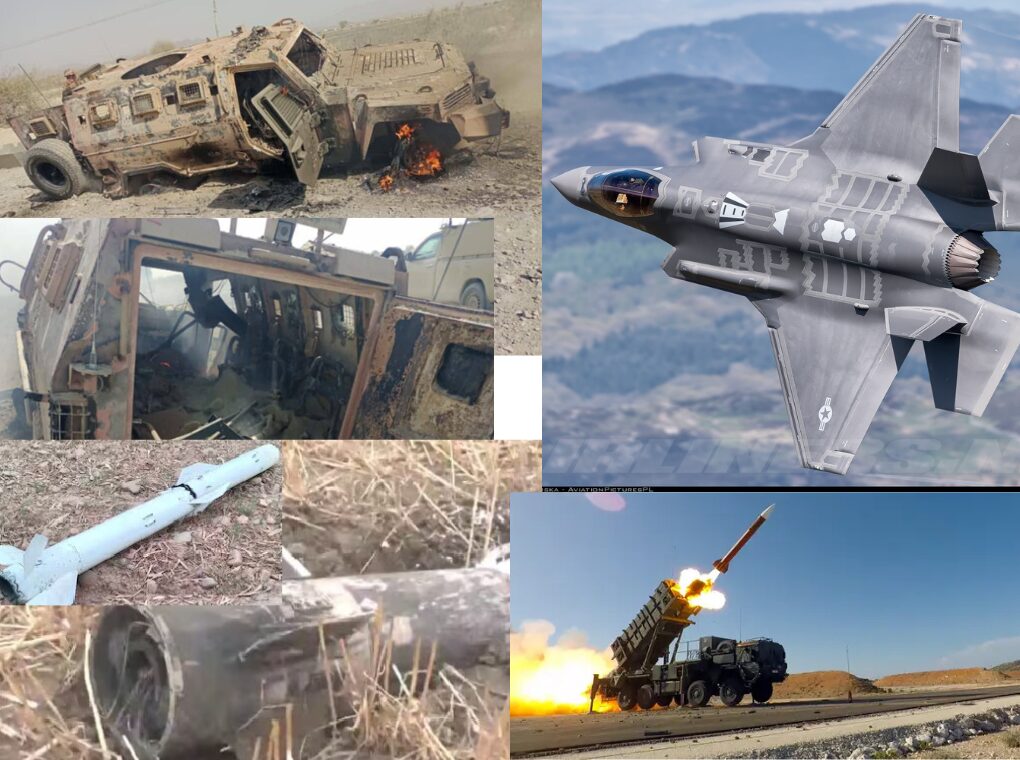
Much of China’s defence equipment is reverse engineered from Russian or Western weapons. But copying a design doesn’t mean replicating its performance. The CH-series drones, based on the U.S. MQ-9 Reaper, have significantly lower endurance and payload capacity. The HQ-9, often compared to the U.S. Patriot system lacks the advanced radar integration and software capabilities of its Western counterparts.
Perhaps most tellingly, Chinese-made DongFeng Mengshi GEN-III APCs, meant to be armoured and resilient, were destroyed by insurgents in Balochistan, raising doubts about their combat viability even in low-intensity conflict zones.
Why does the U.S. and its allies lead?
Western military power is built not only on cutting-edge platforms but on decades of combat experience, global interoperability, and robust support infrastructure. U.S. systems like the F-35, THAAD, and Aegis, and European assets like the Rafale, Eurofighter, and Meteor missiles, are battle-tested and integrated across NATO and allied nations.
Meanwhile, India has emerged as a credible power in its own right. By blending indigenous defence production with advanced systems from the U.S., France, Israel, and Russia, India has developed a hybrid model that’s proving increasingly effective. Its interception of all incoming threats from Pakistan, many equipped with Chinese tech, underscored its operational maturity. Furthermore, India’s use of deception — including dummy aircraft to expose weaknesses in Pakistan’s HQ-9 defences — highlighted its tactical sophistication.
India is no longer a junior partner in the global defence equation. It is now outperforming even China’s top exports on the battlefield.
Global Buyers Reassess Chinese Weapons
While Chinese arms are marketed as affordable alternatives, they come with hidden costs. Countries such as Nigeria, Myanmar, and even Pakistan have experienced frequent breakdowns, software issues, poor after-sales service, and limited upgrade pathways. According to the Stockholm International Peace Research Institute, China’s arms exports fell by 23% between 2013–17 and 2018–22, signaling declining confidence.
Recently, Chinese defence stocks dropped by as much as 9% as investors withdrew their positions, reacting to the dismal performance of Chinese-made weapons.
On the other hand, Western suppliers offer more than just weaponry — they provide training, long-term support, joint exercises, and strategic partnerships that improve overall national security. India is increasingly joining this league, offering defence exports to Southeast Asia and Africa, backed by its growing reputation for quality and performance.
A Superpower in Name Only
China might be a rising economic power, but its ambition to displace the US-led defense order is hitting a hard wall: technology. Real power is measured not by mass production or flashy parades but by performance under pressure. In this regard, Beijing is still years—if not decades—behind.
Its defense industry’s dependency on copied blueprints and unproven tech shows that China remains a superpower in name, not substance.
Conclusion: Power Isn’t Claimed — It’s Proven
China may aspire to rival the West militarily, but it still lacks the real-world credibility that comes from consistent, proven performance. Its weapons may be cheaper, but their combat effectiveness remains highly questionable. And as the world becomes more unstable, nations can no longer afford to prioritize cost over capability.
When tested in battle, China’s military technology is repeatedly outmatched — not just by the United States and Europe, but increasingly by India as well. That’s the true measure of power. And by that standard, China is still playing catch-up in a race where lives, stability, and strategic influence are on the line.