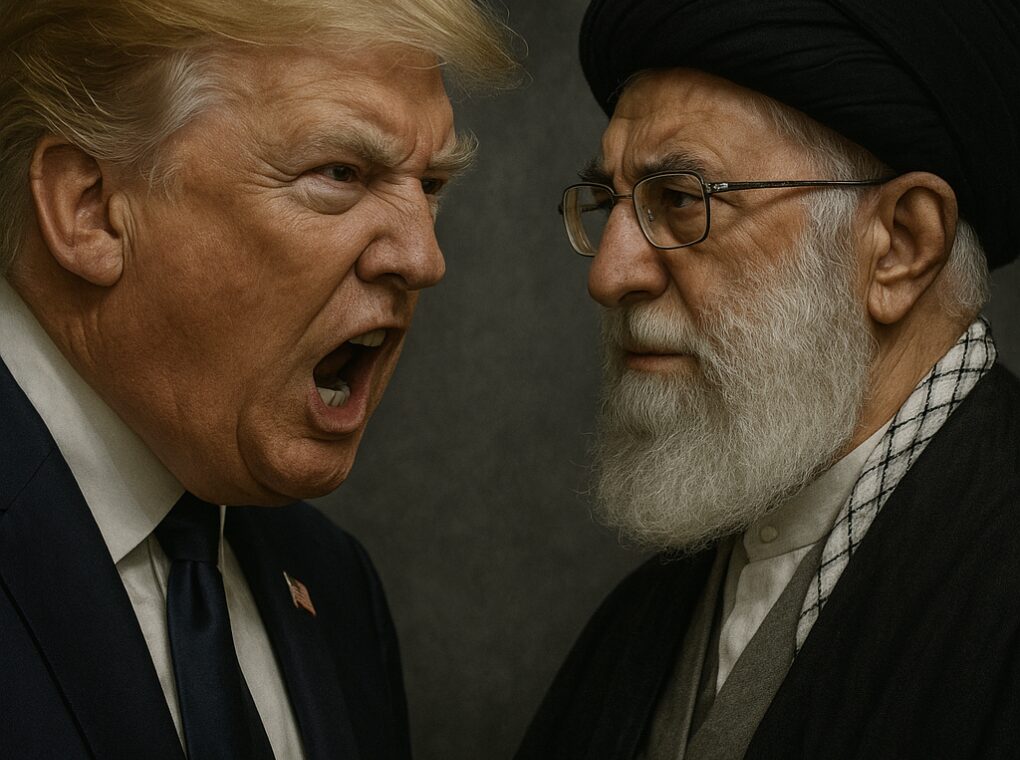
In an unprecedented move that has stunned the world, the United States launched a surprise military strike on Iran, directly targeting three of its most fortified nuclear facilities. The attack marks a major escalation in the simmering Iran–Israel conflict and signals America’s direct military entry into the confrontation.
A Coordinated, High-Impact Strike
In the early hours of Sunday morning, while much of the world was still asleep, U.S. B-2 stealth bombers departed from Whiteman Air Force Base in Missouri and flew nearly 12,000 kilometers to strike Iran’s nuclear complexes at Fordow, Natanz, and Isfahan. The bombers dropped six GBU-57 “bunker buster” bombs, each weighing over 14 tons, designed specifically to penetrate heavily reinforced underground structures.
In addition, 30 Tomahawk cruise missiles were launched, hitting the Natanz and Isfahan facilities. The Fordow facility—buried beneath a mountain—was considered virtually impenetrable until now. According to U.S. President Donald Trump, the site has been “completely destroyed.”
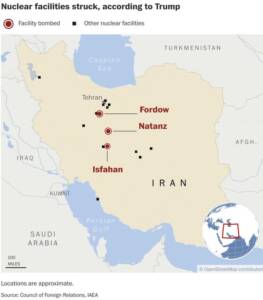
This is the first time in President Trump’s two terms that the U.S. has launched such a direct and large-scale assault on Iranian territory.
Immediate Fallout: Iran Declares Right to Retaliate
Iranian authorities have confirmed “serious damage” to its nuclear infrastructure and declared the country’s right to respond under international law. Iranian Foreign Minister Abbas Araqchi stated, “We are considering all options. This is not only an attack on Iran, but on regional peace and sovereignty.”
Military experts believe Iran may retaliate either by launching missiles at U.S. military bases in the region or by blocking the Strait of Hormuz, a critical chokepoint for global oil shipments.
Why the World Is Watching: The Hormuz Factor
The Strait of Hormuz, controlled in large part by Iran, sees nearly 20% of the world’s oil supply pass through daily. If Iran chooses to mine or blockade this narrow waterway, it could send global oil prices skyrocketing and plunge the world economy into crisis.
Iran has over 3,000 naval mines ready to be deployed, as well as numerous missile boats, submarines, and coastal batteries stationed at key bases like Bandar Abbas and Jask.
U.S. Military Readiness
In anticipation of potential retaliation, the U.S. Navy has deployed two carrier strike groups—USS Harry S. Truman and USS Carl Vinson—to the Gulf region. A third, USS Abraham Lincoln, is on standby.
With over 40,000 U.S. troops stationed across Iraq, Bahrain, Kuwait, Qatar, and other Middle Eastern countries, American forces are bracing for a potential wave of Iranian ballistic missile strikes.
The Bigger Picture: Why Now?
Though President Trump had given Iran a two-week ultimatum over increased nuclear activity, the strike came within 48 hours—likely triggered by alarming intelligence about enrichment activity at Fordow.
Israel, already engaged in long-range airstrikes against Iran, lacked the capability to destroy Fordow’s underground network. The U.S. strike filled that gap, changing the game entirely.
Calls for Restraint Amid War Fears
World leaders from the EU, Russia, China, and the United Nations have urgently called for restraint and de-escalation. However, with Iran’s Islamic regime now facing what it perceives as a direct threat to its survival, a harsh counter-response seems inevitable.
Analysts warn that this could be the most dangerous Middle Eastern crisis since the 2003 Iraq War—only this time, the nuclear stakes are much higher.
The world now teeters on the edge of a larger regional war. Whether Iran strikes back militarily, disrupts the global energy flow via the Strait of Hormuz, or seeks diplomatic resolution under immense pressure remains to be seen. But one thing is certain: the Middle East—and possibly the world—has entered a new and perilous chapter.