
Britain’s military preparedness has come under renewed scrutiny after senior defence figures reportedly warned that the United Kingdom’s supply of military drones could be exhausted within just one week if Russia launched an attack on NATO territory.
The alarming assessment has intensified debate over whether Britain is adequately prepared for a high-intensity European conflict, despite increasingly tough rhetoric toward Moscow from Prime Minister Keir Starmer and NATO allies.
The concerns emerged during a major military rehearsal exercise in London, where British commanders simulated a response to a hypothetical Russian assault on a Baltic NATO member state. Defence sources reportedly described the UK military as “chronically ill-equipped” for a sustained conflict, raising serious questions about Britain’s weapons stockpiles, troop readiness, and industrial capacity to support a prolonged war effort.
UK Military Faces Severe Drone Shortages
According to senior officers involved in recent military planning, Britain’s current drone inventory could be depleted within the first seven days of combat in a major war scenario. While the exact figures remain classified for national security reasons, military insiders suggested that shortages extend beyond drones to include ammunition, weapons systems, and battlefield logistics.
The warning comes at a time when drones have become one of the most decisive tools in modern warfare, particularly following lessons learned from the war in Ukraine. British military planners reportedly estimate that more than 90 percent of casualties in parts of the Ukraine conflict have been inflicted using unmanned systems, underscoring the growing importance of drone warfare.
Officials fear Britain would struggle to sustain operations in the opening phase of any large-scale NATO confrontation with Russia, especially if conflict erupted suddenly along NATO’s eastern flank.
Secret NATO Exercise Beneath London
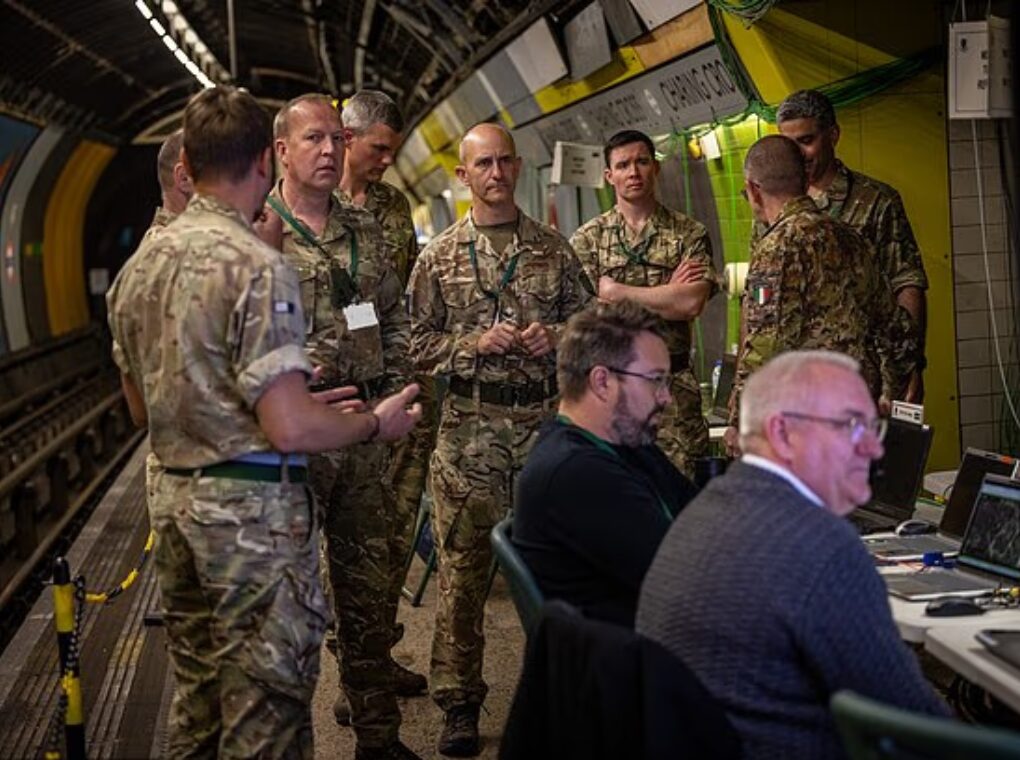
The concerns surfaced during a classified military exercise known as “Exercise Arrcade Strike,” staged beneath central London in a disused Underground facility near Charing Cross Station.
British commanders transformed the abandoned transport site into a mock NATO command center, rehearsing how allied forces would coordinate operations if Russia advanced into the Baltic region.
The underground location reflected modern battlefield realities, where military headquarters must remain protected from missile strikes, drones, and electronic surveillance.
The exercise reportedly involved British personnel working alongside troops from France, Italy, and the United States, testing NATO’s ability to coordinate tens of thousands of troops during a high-intensity war.
Military officials practiced using AI-integrated drone systems, battlefield mapping technologies, and long-range strike coordination. Sophisticated software reportedly enabled commanders to visualize battlefields in real time while accelerating military planning processes that traditionally took days.
According to commanders, artificial intelligence is increasingly being integrated into logistics, targeting, and intelligence analysis. Britain’s military AI platform, called “Asgard Decide,” reportedly reduces planning cycles from 72 hours to just two.
Britain May Not Be Fully Ready Until 2030
Perhaps the most striking warning came from Lieutenant General Mike Elviss, commander of NATO’s Allied Rapid Reaction Corps (ARRC), who suggested Britain may not be fully prepared to respond effectively to a Russian military threat until 2030.
Elviss reportedly stated that Britain could realistically achieve the necessary level of modernization and readiness only if significant investment is made immediately. Without urgent funding and expanded domestic weapons production, commanders fear British forces could face devastating losses in a modern war.
The UK currently spends approximately 2.6 percent of its GDP on defence. By comparison, NATO allies such as Poland and Lithuania spend significantly higher percentages relative to their economies, particularly due to security concerns along NATO’s eastern border.
The government led by Starmer has pledged to increase defence spending to 2.7 percent next year while maintaining ambitions to eventually reach 3 percent of GDP. However, military commanders argue that accelerated investment is needed much sooner.
NATO Preparing for a More Dangerous Europe
The UK currently leads NATO’s Allied Rapid Reaction Corps, a force of around 30,000 troops designed to deploy rapidly if Russia advances into Eastern Europe. That force could be reinforced by NATO reserve formations numbering up to 100,000 troops across land, sea, air, cyber, and space domains.
Senior NATO officials argue that maintaining credible deterrence remains essential to preventing war.
General Alexus Grynkewich, NATO’s Supreme Allied Commander Europe (SACEUR), emphasized that visible military preparedness is necessary to deter future aggression.
He also reportedly issued a subtle warning regarding Britain’s military commitments, stressing that NATO’s defence architecture depends heavily on the UK maintaining a fully operational rapid reaction force.
Debate Over Russia Threat Intensifies
The military assessment is likely to fuel political debate inside Britain and across Europe over the scale of the Russian threat and NATO’s future strategy.
Some European leaders continue advocating stronger deterrence and increased military spending, arguing that Russia’s war in Ukraine demonstrates the risks of underestimating Moscow’s capabilities.
Others continue calling for diplomatic engagement alongside military preparedness.
Recently, discussions around future negotiations with Vladimir Putin have resurfaced in parts of Europe, with some political figures arguing that diplomacy must remain an option to reduce long-term security risks.
At the same time, NATO governments maintain that strengthening defence capabilities is necessary regardless of whether negotiations take place.
Britain Accelerating Drone Expansion
In response to battlefield lessons from Ukraine, Britain is already increasing investment in military technology.
The UK government has committed approximately £4 billion toward expanding drone capabilities. The British Army has reportedly received 6,000 additional drones this year, with another 8,000 “One Way Effector” drones expected to enter service by the end of 2026.
Meanwhile, the Royal Navy is also moving toward hybrid warfare models involving unmanned ships and submarines operating alongside traditional fleets.
Despite these efforts, military leaders warn that current stockpiles remain insufficient for the type of sustained, high-intensity warfare now shaping modern conflicts.
As Europe confronts what officials describe as its most dangerous security environment in decades, Britain’s defence readiness—and whether it can rapidly modernize before 2030—may become one of NATO’s most urgent strategic questions.