
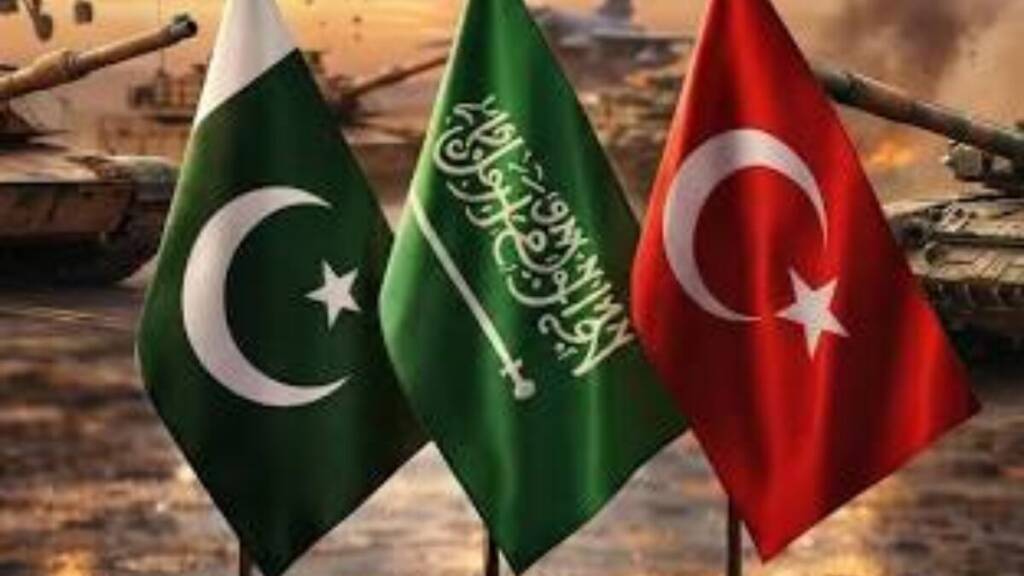
Saudi Arabia, Pakistan and Turkey signed a mutual defence agreement in Jeddah on Friday, Pakistan’s foreign ministry and Saudi broadcaster Al Arabiya confirmed — tying together the Gulf’s biggest oil producer, NATO’s second-largest army, and the Muslim world’s only nuclear-armed state into a single security framework. Al Arabiya is calling it the “Mecca Joint Defence Agreement.”
The pact stipulates that any armed attack against any one of the three states shall be regarded as an attack against them all.
Crown Prince Mohammed bin Salman hosted Turkish President Recep Tayyip Erdogan and Pakistani Prime Minister Shehbaz Sharif in the Red Sea city for the signing. Sharif, accompanied by army chief Field Marshal Asim Munir, had arrived in the kingdom on Thursday and performed the Umrah pilgrimage in Mecca on Friday morning before the ceremony. Erdogan arrived later in the day for what his office had described as a one-day working visit.
Why now
The signing lands against the backdrop of the ongoing US-Iran war, now in its sixth month. Since strikes on Iran began on February 28, Tehran has repeatedly shut the Strait of Hormuz — the channel through which roughly a quarter of the world’s seaborne oil normally moves — and Saudi Arabia has absorbed spillover from the conflict for five months, including strikes from Iran itself The signing lands against the backdrop of the ongoing US-Iran war, now in its sixth month. Since strikes on Iran began on February 28, Tehran has repeatedly shut the Strait of Hormuz — the channel through which roughly a quarter of the world’s seaborne oil normally moves — and Saudi Arabia has absorbed spillover from the conflict for five months, including strikes from Iran itself and from Iran-backed Houthi and Shiite militia groups.and from Iran-backed Houthi and Shiite militia groups.
A source close to the deal put it plainly to AFP: “It was under discussion for a long time, but the latest developments in the region expedite it.” Pakistan’s foreign ministry spokesman Tahir Andrabi had struck a similar note the day before signing, saying the visit “will carry significance beyond the immediate crisis and short-term considerations.”
Building on an existing pact
Friday’s trilateral agreement builds on a bilateral foundation Saudi Arabia and Pakistan laid nearly a year ago. In September 2025, Mohammed bin Salman and Sharif signed a Strategic Mutual Defence Agreement in Riyadh, under which the two countries committed that any act of aggression against one would be treated as aggression against both. That pact drew immediate attention for one reason: Pakistan is the only Muslim-majority nation that possesses nuclear weapons, raising the question of whether Saudi Arabia had effectively acquired access to a nuclear umbrella.
Turkey’s addition to the framework deepens that significance considerably, bringing NATO’s second-largest military into the same security architecture.
“Islamic NATO” talk resurfaces
The signing has revived long-running speculation about a so-called “Islamic NATO” — a unified military bloc of Muslim-majority nations aimed at defending collective interests. Commentators note that Pakistan’s growing insertion into the Middle Eastern strategic equation, combined with the emergence of such a bloc, carries significant implications for Gulf security, regional power dynamics, and global strategic calculations.
India watching closely
New Delhi is tracking the development carefully. Indian coverage has framed the pact as one that signals a major shift in regional alliances. Given Pakistan’s role as the nuclear-armed party in the arrangement — and the still-fresh memory of the India-Pakistan military clash earlier this year — the extension of a trilateral mutual-defence framework involving Islamabad is likely to draw sustained attention from India’s security establishment, even as New Delhi maintains a measured public posture toward Riyadh and Ankara individually.
The precise text of the agreement — particularly whether the mutual-defence clause is worded as unambiguously as the Saudi-Pakistan pact — will determine how seriously the three militaries intend it to function as a binding alliance rather than a symbolic show of unity. With Sharif’s delegation in Jeddah until Saturday, further detail on the agreement’s scope may emerge before the visit concludes.