Till only recently, China seemed invincible in the Middle East. The country managed to get involved in Riyadh’s ballistic missiles development program, amidst deteriorating US-Saudi ties. And the country has also managed to come close to Iran with a $400 billion agreement that would allow China to access a secure supply of oil from the Shi’ite country.
Read more: Alienated by the US, Saudi Arabia is developing ballistic missiles with China
You would think that you have won over the Middle East if you have managed to woo both Tehran and Riyadh, because these two rival powers wield considerable influence in the region. But China is now getting replaced in the region by one of its old enemies- South Korea.
South Korea and China- an old hate story
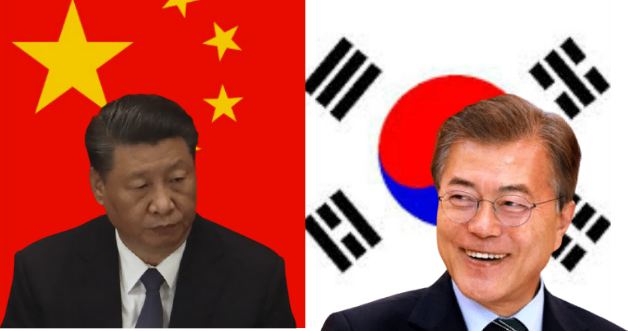
South Korea is one of the biggest enemies of China. For decades, Beijing has been blackmailing Seoul with its client state- North Korea. China has used Pyongyang as an indirect nuclear threat against South Korea.
And then, China also stakes a claim on Seoul’s Exclusive Economic Zone (EEZ) in the Yellow Sea. So, it makes a lot of sense for Seoul to replace China in the Middle East and settle scores.
South Korea starts talking to Gulf powers
With an eye on China, Seoul will resume free trade agreement talks with the Gulf Cooperation Council (GCC) in the first quarter of this year. Nearly 12 years ago, the talks between South Korea and the GCC, an alliance of six Middle East nations, were halted.
On the occasion of South Korean President Moon Jae-in’s visit to Saudi Arabia, the two countries agreed to resume free trade agreement talks. The decision was announced by Korea’s Minister for Trade Yeo Han-Koo and GCC Secretary-General Nayef Falah M. Al-Hajraf.
Seoul is starting its Middle East outreach with the six-nation alliance that remains its key trading partner in the Middle East. GCC-South Korea trade stood at $46.6 billion in 2020, and accounted for 78 percent of the country’s trade with the region.
Seoul to pull the Middle East out of Beijing’s clutches
Moon knows that China wants to monopolise the Middle East economy, by grabbing a lion’s share in its oil exports industry. Moon, therefore, noted efforts by GCC nations to diversify their oil-dominated industrial portfolio.
The South Korean President is the promising establishment of future-oriented businesses in the region and access to Seoul’s next-gen tech capabilities that would help change the fundamental character of GCC nations’ oil-dominated economy. Seoul can help Middle East nations gain access to a diversity of sectors like hydrogen, renewable energy and healthcare.
LG to establish regional headquarters in Riyadh
South Korea and GCC have just started talking about a free trade agreement. A deal hasn’t been struck till now. But Korean businesses are already looking to establish a presence in the region.
South Korea’s LG Corp is planning to establish its regional headquarter in Riyadh. With the electronics giant establishing itself in Riyadh, South Korea is trying to improve its ties with the world’s top oil exporter and the kind of the Arab world- Saudi Arabia.
Riyadh was getting somewhat restless with the emergence of its long-time ally, the United Arab Emirates, as a regional business hub. Saudi Arabia felt that it was lagging behind in the region and therefore it had also issued an ultimatum to global corporate giants- establish headquarters in Saudi Arabia by 2023 or risk losing out on government projects.
Seoul grabbed the opportunity and with LG establishing headquarters in Riyadh, South Korea can tell Saudi Arabia that it actually wants to help the Arab Kingdom develop into a diversified economy.