President Donald Trump’s latest travel ban—set to take effect on June 9, 2025—marks the return of one of his most controversial policy tools from his first term. Though not an exact replica of the 2017 “Muslim Ban,” the new order retains familiar themes: a heavy focus on national security, a sweeping list of restricted countries, and a divided public response. What’s new, however, is its expanded scope, improved clarity, and more detailed justifications.
The New Travel Ban: Who’s Affected?
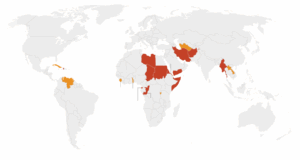
The 2025 travel proclamation imposes a full entry ban on nationals from 12 countries:
Afghanistan
Chad
Republic of the Congo
Equatorial Guinea
Eritrea
Haiti
Iran
Libya
Myanmar
Somalia
Sudan
Yemen
In addition, the order places partial visa restrictions—including suspensions of tourist (B-1/B-2), student (F/M), and cultural exchange (J) visas—on seven other countries:
Burundi
Cuba
Laos
Sierra Leone
Togo
Turkmenistan
Venezuela
This sweeping reach touches Africa, the Middle East, Asia, Latin America, and the Caribbean, and affects more nations and people than any of Trump’s prior travel bans.
A Shift in Framing
Unlike the 2017 ban, which drew international condemnation for targeting Muslim-majority nations and sowing chaos at airports, the 2025 version comes with a different tone and structure. The administration frames it not in religious or ethnic terms, but as a policy rooted in data: nations were selected based on three criteria:
Poor screening and document verification systems
High rates of visa overstay
Links to terrorism or state sponsorship of terror
This framework, while more legally sound and diplomatically defensible, is still open to challenge—especially when some countries with similar or worse records are notably absent.
Exemptions: A Key Difference
One of the most notable changes from the 2017 ban is the clear articulation of exceptions. The following groups are exempt from the 2025 ban:
Lawful permanent residents (green card holders)
Dual nationals traveling on a passport from a non-restricted country
Diplomats and official representatives
Athletes and their immediate families attending major international sports events
Afghan Special Immigrant Visa (SIV) holders who aided U.S. forces
Refugees already granted asylum
Persecuted minorities, including Iranian Christians and other religious minorities
These carve-outs suggest that the administration has learned from the confusion and legal backlash of 2017, when visa holders were abruptly detained or deported.
Politics, Security, or Optics?
The timing and political context of the ban can’t be ignored. Coming just five months into Trump’s second term and following a terror incident in Colorado—involving an Egyptian national (a country not listed in the ban)—the move appears designed as much to reassure Trump’s base as to genuinely recalibrate immigration risk.
The administration argues that the order is a proactive security measure, not a reactive punishment. But critics see it as overbroad, unnecessarily punitive, and a thinly veiled continuation of Trump’s original restrictive immigration agenda.
Global and Human Impact
While the number of people affected by the ban is relatively small in the broader context of U.S. immigration, for those individuals—and their families—the consequences are real and often heartbreaking.
According to 2024 State Department data, over 170,000 visas were issued to nationals from the now-banned countries last year. Many of these were immigrant visas granted to close family members of U.S. citizens or Special Immigrant Visa applicants from Afghanistan, Yemen, and Somalia. For them, the ban disrupts reunification, education, and opportunity.
Furthermore, the inclusion of countries like Haiti, Cuba, and Venezuela adds a sensitive geopolitical layer, especially given ongoing instability and humanitarian crises in those nations.
Conclusion: A Policy of Contrasts
The 2025 travel ban is more organized and arguably more defensible than the chaotic rollout in 2017. It features a legal grace period, transparent exemptions, and broader criteria for inclusion. But its core issues remain unchanged: Does it truly improve national security, or does it cast too wide a net? Is it based on evidence, or politics?
In trying to prevent potential threats, the U.S. risks alienating nations, harming families, and repeating history under a different name. Stronger vetting and cooperation with foreign governments are worthy goals—but they shouldn’t come at the cost of blanket exclusion or moral inconsistency.
Security matters. But so does fairness. And policies that affect thousands of lives must be held to a higher standard than fear and political expediency.