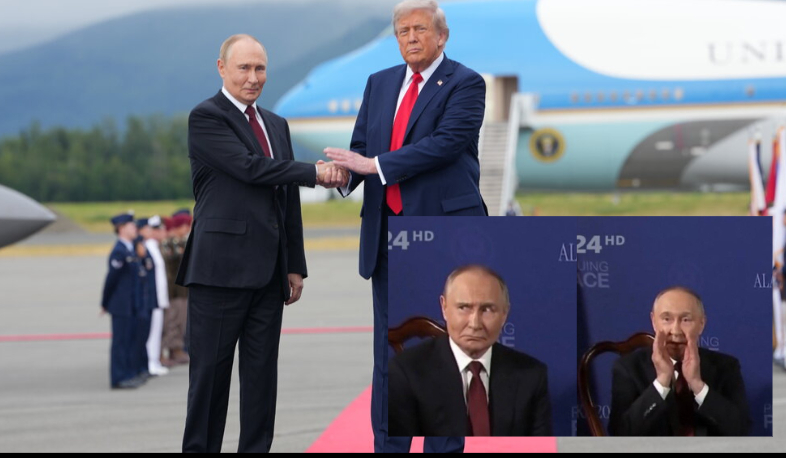
In the ever-theatrical world of global politics, few moments generate as much intrigue as a meeting between two of the most high-profile figures in modern history: US President Donald Trump and Russian President Vladimir Putin. But following a recent meeting between the two, a swirl of online speculation has emerged: was it Putin who met Trump, or was it one of his infamous body doubles?
Observers noted subtle but striking differences in Putin’s appearance and demeanor. Social media sleuths pointed out supposed inconsistencies in his gait, facial expressions, and even hand movements. This led some to suggest that the Russian president may have deployed a body double, a theory that has circulated for years.
Suspicious Putin meets Trump
The suspicion surrounding this particular Putin-Trump meeting wasn’t random. Several unusual details caught the attention of analysts, critics, and casual observers alike, all fueling theories that the man who showed up might not have been the real Vladimir Putin.
The suspicions began when Putin was walking with Trump and started looking around at the US fighter jets even in the sky. Putin is a very focused individual and will not be amused by fly-bys and jets in such a serious meeting. Many analysts found the behavior odd from the get-go.
Moreover, Putin appeared noticeably fuller in the face than in recent months, with subtle changes to his jawline and skin tone. Some speculated this could be due to illness, cosmetic intervention, or… impersonation.
Facial recognition comparisons circulating online showed minor asymmetries and discrepancies in ear shape, a common focus in body double theories.
During public remarks, Putin’s voice was softer and more monotone than usual, with an unusually measured cadence. His reactions to the US reporters were of apparent surprise and gave away his entire demeanour. Analysts believe this is something a trained KGB man like Putin would not allow.
Linguists also noted a lack of his typical sharp delivery or dominant body language, which many associate with his calculated leadership style. The “Putin” who appeared with Trump kept unusually still, rarely using expressive hand gestures, which some analysts say is inconsistent with the Russian president’s historical public behavior.
Right arm mobility appeared inconsistent with past appearances, where his right hand was noticeably stiff, something that had fueled prior speculation about neurological conditions.
His walk appeared more rigid and cautious than usual. In previous appearances, Putin has been known for a distinctive “gunslinger’s gait,” a purposeful walk with one arm swinging and the other held rigidly — believed to be a KGB training artifact. This trademark movement was reportedly absent.
Perhaps most surprisingly, observers noted that Putin appeared less assertive in the interaction with Trump than expected. Historically, Putin has exuded dominant body language in bilateral meetings, especially with Western leaders. In this case, he appeared overly deferential, almost passive.
Combined, these behaviors painted a portrait that felt off, not drastically, but subtly enough to raise eyebrows, especially among those already suspicious of Kremlin’s tactics.
Putin’s Body Double Program
There have been rumors of Vladimir Putin using body doubles dating back to the early 2000s. Though officially denied by the Kremlin, speculation has persisted, and on several occasions, even been subtly acknowledged by Russian insiders.
Russian media and opposition figures first floated the idea when Putin began showing up at multiple engagements on the same day in distant locations, with remarkably different appearances, some photos showing a broader face or different posture.
Critics noted changes in facial structure, leading to suggestions of either plastic surgery or the use of impersonators.
Over time, observers began attributing differences in his appearance and behavior to possible health issues, prompting the idea that doubles might be used during his recovery or for security reasons.
In 2020, Putin himself publicly denied using body doubles, saying the idea had been proposed by security services in the early 2000s but was rejected.
In 2023, a former Russian intelligence officer (allegedly defected) told European outlets that body doubles were being used more frequently. Some Ukrainian and Western officials, including military spokespersons, have fanned the speculation, pointing to “odd behavior” in Putin’s public appearances.
Historically, speculation about body doubles isn’t new. Rumors dogged leaders like Saddam Hussein and even the USSR leader, Joseph Stalin. In Putin’s case, former Kremlin insiders have hinted that doubles were considered for security reasons, though official Russian sources have always denied their use.
What Russia and the US achieved in the meeting
Regardless of who showed up, the real Putin or not, both sides appear to have gained politically or strategically from the encounter.
Putin has now gained mainstream legitimacy on the global stage. A meeting with Trump gives Putin continued relevance despite supposed international isolation over the Ukraine war. Moreover, Trump has indicated that he will not currently impose impose tariffs or sanctions on Russia’s trade partners, signaling a big win for Moscow.
The meeting may further fuel division in the West, painting Trump as open to Russian engagement, and undermining NATO’s unified stance against Moscow. This also takes away from Ukraine and Western Europe’s stance, which does not seek to negotiate with Putin in such a manner.
On the other hand, the meeting with Putin strengthens Trump’s “global dealmaker” persona and differentiates him from Biden’s confrontational stance on Russia.
As always, Trump dominates headlines this time for international diplomacy, keeping his base energized and the spotlight squarely on him. Through this, his pursuit of the Nobel Peace Prize also continues. Trump knows that if he manages to find a solution to the Russia-Ukraine clash, he will have a huge narrative behind him to get the elusive and prestigious award and recognition the White House has been asking for him.
With or without a body double, the Kremlin is positioning itself for the next phase of global power dynamics. From extending the war in Ukraine and testing NATO unity, to managing the political divide between Europe and the US. Putin is playing a long, adaptive game, and there are few better masters at it than him.